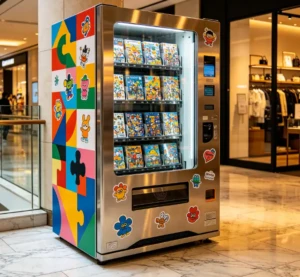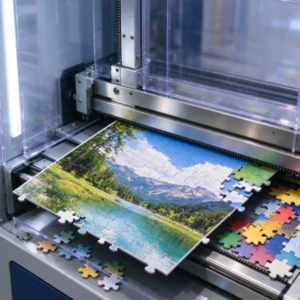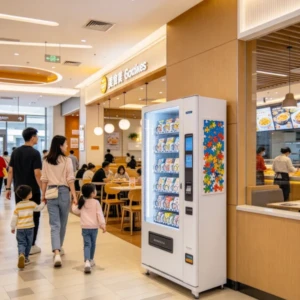
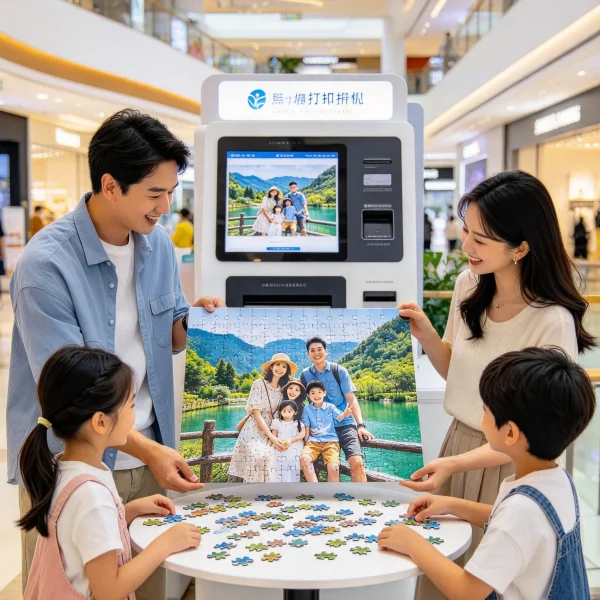
A puzzle vending machine is a self-service kiosk that UV-prints a customer’s photo onto a rigid board and die-cuts it into a finished jigsaw puzzle on the spot, usually in 3 to 5 minutes. You’ll see them in shopping malls, aquariums, children’s museums, and at wedding receptions where guests want something better than an engraved keychain. The customer scans a QR code, uploads a photo from their phone, picks a piece count, pays by card or coin, and watches the machine do the rest. Nothing drops out of a pre-filled hopper, so every puzzle is one of a kind.
How a photo puzzle kiosk turns a phone photo into a finished jigsaw
Think of it as a small print shop in a steel cabinet. The customer scans a code on the touchscreen, opens a page on their own phone, and uploads an image. Some machines also take a USB stick or let people pick from built-in templates for birthdays, anniversaries, and holidays.
After the upload, the kiosk shows a preview with crop guides. That matters more than it sounds. Nobody wants to pay $9 and find out their grandmother’s head is missing from the frame.
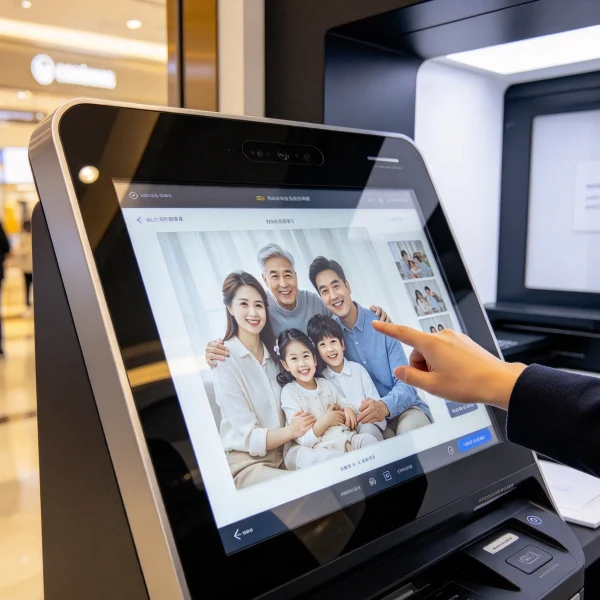
Then it’s a straight line: pick the size, pay, wait. Card readers are standard on 2026 models, and most units still keep a coin acceptor and a bill validator for the grandparent trade.
The four steps a customer sees
- Upload. A QR code, a USB stick, or a built-in template. Photos sit on the local drive, which is the first thing privacy-minded parents ask about.
- Preview and choose. Piece count, board size, and whether they want a gift box.
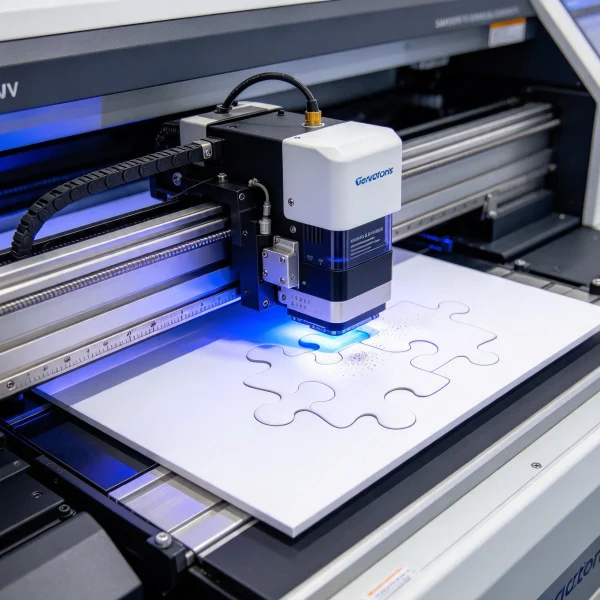
- Print. A UV head lays down cyan, magenta, yellow and black ink plus a white underlayer on coated board, so colors stay sharp instead of soaking into the surface.
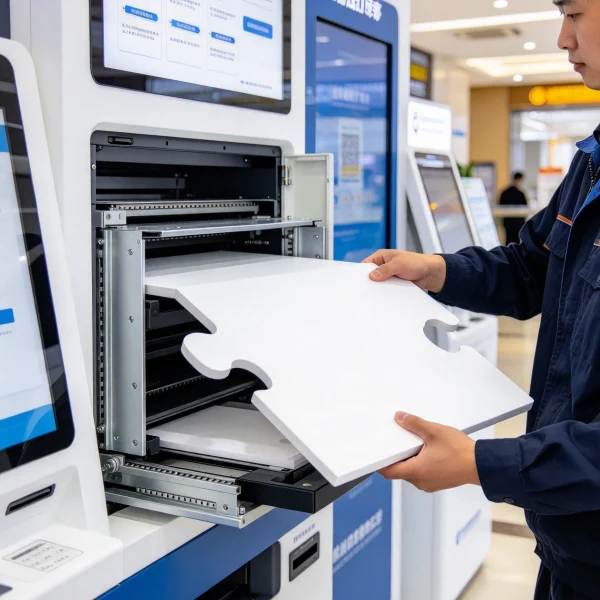
- Cut and drop. A blade follows a puzzle-shaped path, and the finished puzzle slides into a tray inside a protective sleeve.
Printing runs 60 to 120 seconds depending on board size. The cutting pass adds another 60 to 180. Add the upload and preview time and you land on the 3 to 5 minute figure suppliers quote.
What’s inside the machine
You don’t need to be an engineer to buy one of these, but you should know which parts wear out and what they cost to replace. The two expensive components are the print head and the cutting system.
- UV flatbed print head, typically an industrial Epson or Ricoh head running 720 to 1440 dpi
- Vacuum bed that holds the board flat during printing and cutting
- Drag knife or die-cutting head that follows the puzzle pattern
- Board magazine holding 50 to 200 blanks
- Touchscreen, usually 21 to 32 inches
- Payment stack: MDB protocol board, coin acceptor, bill validator, card reader, QR wallets
- 4G or WiFi module for remote monitoring and error alerts
- Steel cabinet weighing 100 to 250 kg depending on format
Here’s how the three common formats compare, using price ranges buyers report when they collect quotes in 2026.
| Format | Max board size | Piece counts | Cycle time | Price range (USD) | Power draw |
|---|---|---|---|---|---|
| Compact single head | 20 x 20 cm | 12, 24, 48 | 3 to 4 min | $3,800 to $6,500 | 500 to 800 W |
| Standard single head | Up to A3 (30 x 42 cm) | 48, 60, 100 | 4 to 6 min | $7,000 to $13,000 | 900 to 1,300 W |
| Dual head, high volume | A3+ (33 x 48 cm) | 100, 120, 200 | 2 to 3 min | $14,000 to $26,000 | 1,300 to 2,000 W |
Power matters if the spot you’re eyeing has no dedicated circuit. A dual-head unit can pull close to 2 kW during a print cycle, and mall electricians ask about that before they approve anything.
What a puzzle vending machine costs in 2026
Expect $3,800 to $26,000 for the machine itself. That range is wide for real reasons: print head quality, the cutting mechanism, cabinet size, payment hardware, and whether the quote is FOB from a factory or a landed price with freight and duty already inside it.
Two quotes for machines that look identical can differ by 40% because one includes a card reader and the other doesn’t. Read the spec sheet line by line and ask which items are optional.
A word on comparing quotes: do it on the same spec, otherwise you’re ranking brochures. On VendingCore you can compare verified suppliers, read buyer reviews, and check price ranges before you email anyone.
Freight on a cabinet this size runs $400 to $1,200 depending on the route, and that’s before duty. Then there’s the part nobody puts in the brochure: an initial board order, sleeves, a spare cutting head, and a merchant account for card processing. Set aside $1,000 to $2,500 on top of the machine price. If this is your first vending purchase, the realistic 2026 startup budget breakdown lists the line items people forget.
Where these kiosks actually earn
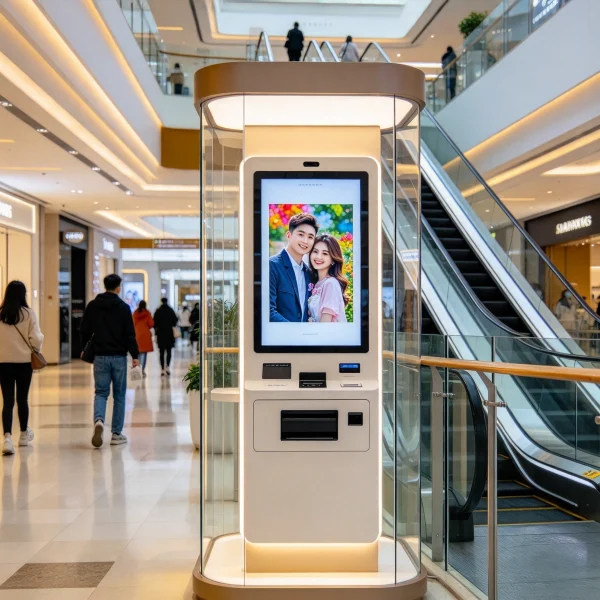
Personalized-print machines depend on two things: dwell time and a reason to celebrate. Put one in a corridor and it dies. Put it where people are already waiting, or where they’ve just done something worth remembering, and it works.
Locations that keep showing up in operator reports:
- Regional malls with a cinema or family entertainment anchor
- Aquariums, zoos, and science centers, ideally near the exit
- Theme park and attraction gift shops
- Holiday markets and seasonal fairs with a four to six week run
- Hotel lobbies in tourist cities
- University bookstores during graduation week
The location logic is nearly the same as for phone case vending machines in shopping malls, another personalized-print kiosk: same foot traffic, same willingness to hand over $10 for a souvenir with their own photo on it.
Seasonal spikes follow the calendar. Mother’s Day weekend, graduations, and the run-up to Christmas can double a kiosk’s weekly output, which is worth more than a big traffic number because you can pre-stock boards for it.
The money math on one machine
Treat this as a model, not a promise. Take a mid-range single-head kiosk at $11,000, a blended average sale of $9 (a mix of 48-piece and 100-piece puzzles), and consumables at $0.80 per puzzle covering board, ink, and sleeve.
At 8 puzzles a day, that’s 240 a month, or $2,160 in gross sales. Subtract $192 in consumables, roughly $380 in revenue share at 18%, and about $65 in card fees. You’re left with something near $1,520 a month before service visits and travel.
That puts payback around 7 to 9 months on this machine. Double the daily volume in a strong mall and it drops to 4 to 6 months. If you want to run the same net-income exercise on a different category, this cotton candy vending machine profit margin calculator handles the fixed costs the same way.
Puzzle kiosk vs capsule prize machine vs retail jigsaw
These three get mixed up constantly, partly because puzzles and vending keep landing in the same sentence. They’re different businesses with different economics.
| Option | What the customer gets | Unit cost | Retail price | Setup cost | Best for |
|---|---|---|---|---|---|
| Photo puzzle kiosk | Their own photo as a jigsaw, 12 to 120 pieces | $0.55 to $1.10 | $6 to $15 | $4,000 to $26,000 | Malls, attractions, events with dwell time |
| Capsule prize machine | Pre-made mini puzzle in a plastic capsule | $0.30 to $0.90 | $1 to $2 | $1,500 to $4,000 | Arcades, store entrances, impulse traffic |
| Retail jigsaw on a shelf | Branded puzzle bought from a wholesaler | $4 to $9 | $12 to $25 | Inventory only | Gift shops with staff on site |
A capsule machine selling mini puzzles costs a fraction of a kiosk and never asks a customer for anything but coins. It also caps your sale at a dollar or two and gives the buyer no reason to come back next month. The kiosk is the one that turns a phone photo into a $10 purchase.
What to check before you buy from any supplier
Ask for a printed sample with your own photo on it, mailed to your address. A picture of a finished puzzle tells you nothing about how a blade behaves at the end of its life on a 2 mm board.

Then go through this list with every supplier, and write the answers down so you can compare them later:
- Print resolution and ink type, and whether white ink is standard or optional
- Board thickness, usually 1.5 to 2.5 mm, and whether generic board fits or you’re locked into the supplier’s stock
- Cutting head life measured in puzzle counts, plus the replacement price
- Payment: MDB support, a card reader certified in your country, QR wallet options
- Remote monitoring and error alerts over 4G or WiFi
- Spare parts lead time, and who pays shipping when something breaks
- Warranty length and exactly what it excludes
- Software fees, cloud subscriptions, or per-print licences
- Compliance marks for your market: CE, FCC, or UL
- Installation, training, and who you call on a Saturday when it jams
If you’re sourcing directly from a factory, the questions are the ones in this China sourcing guide for vending machines: who handles QC, what the real lead time is, and who pays when a cabinet arrives with a cracked panel. The question list in this 2026 buying guide for cotton candy machines translates to photo kiosks almost word for word, because the supplier dynamics are the same.
Next step: compare suppliers before you commit
The short version: a puzzle vending machine is a photo-print kiosk that makes a personalized jigsaw in a few minutes. It costs between roughly $4,000 and $26,000 depending on format, and the location you sign matters more than the badge on the cabinet.
Before any deposit, get three quotes on the same spec. Ask each supplier for the consumable price list, blade life, warranty terms, and spare part lead time. The lowest quote is rarely the lowest cost.
On VendingCore you can compare verified suppliers side by side, read reviews from buyers who already run these machines, and send an inquiry directly instead of collecting business cards at a trade show. You’ll walk away knowing what you’re buying, what it costs per puzzle, and how long until the machine pays you back.
FAQ
What is a puzzle vending machine used for?
It lets someone turn a photo into a jigsaw puzzle while they wait. Customers upload an image, choose a piece count, and pay; the kiosk prints the photo onto board and cuts it into puzzle pieces in three to five minutes. Operators place them in malls, aquariums, museums, and at events where people want a personalized keepsake rather than a generic souvenir.
How much does a puzzle vending machine cost?
Prices run from about $3,800 for a compact single-head unit to $26,000 for a large dual-head machine built for volume. Most first-time buyers spend $7,000 to $13,000 on a standard single-head kiosk. Add $1,000 to $2,500 for freight, duty, an initial board order, a spare cutting head, and card processing setup.
How many pieces can one puzzle have?
It depends on the board and the cutting software. Common options are 12 and 24 pieces for small children, 48 to 60 for families, and 100 or 120 for adults. The same board blank can produce different piece counts, so most operators stock one size and let the software handle the rest. Confirm the maximum count with the supplier before ordering.
How long does one puzzle take to make?
Three to five minutes from payment to dispensing. Printing a 20 by 30 centimeter board takes roughly 60 to 120 seconds, and the cutting pass adds another 60 to 180 seconds depending on piece count. Larger boards and higher piece counts sit at the top of that range. Upload time depends on the customer’s phone, not the machine.
How much money can one machine make?
On a decent mall placement, 6 to 12 puzzles a day is realistic, with more on weekends and holidays. At an average $9 sale and $0.80 in consumables, that’s roughly $1,200 to $2,300 a month after revenue share and card fees. Payback on an $11,000 machine usually lands between 4 and 9 months.
Does it need staff or an internet connection?
Not staff. Customers run it themselves from the touchscreen, so it works from opening to closing with nobody on site. You still visit to refill boards, empty the coin box, and check the blade. Internet isn’t required to print, but you want it for remote monitoring, card payments, and error alerts, otherwise a jam sits unnoticed for a day.
What’s the difference between this and a capsule puzzle toy machine?
A capsule machine dispenses a pre-made mini puzzle in a plastic ball for $1 or $2 and never touches a customer’s photo. A puzzle vending machine is a print-and-cut kiosk that produces a personalized jigsaw selling for $6 to $15. The capsule unit is cheaper to buy and simpler to run; the kiosk earns more per transaction and depends heavily on location quality.
How do I find a reliable supplier?
Start with suppliers other operators actually use. On VendingCore you can compare verified suppliers side by side, read buyer reviews, check price ranges, and send an inquiry directly instead of guessing from a trade show booth. Ask each one for a printed sample with your photo, a consumable price list, warranty terms, and spare part lead times before you pay a deposit.
The machine is the easy part. What separates a kiosk that pays for itself in six months from one that sits in a corner is the lease and the consumable math. I’ve watched operators sign flat rent at $900 a month because the mall looked busy, then find out the traffic walks past on the other side of the escalator. Get 90 days to test, or a revenue share. And ask for the per-puzzle cost in writing, because a machine that costs $2,000 more but runs generic board and cheap cartridges is often the cheaper one over three years.