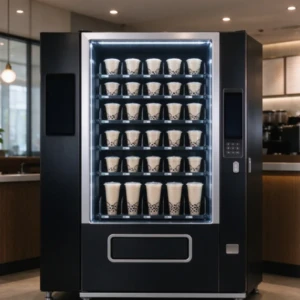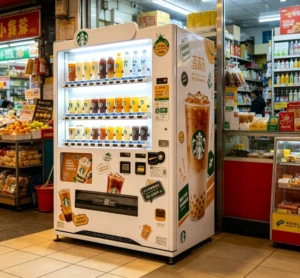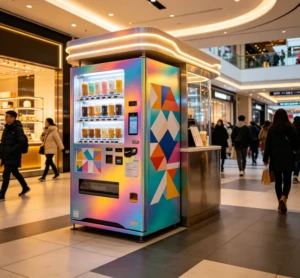
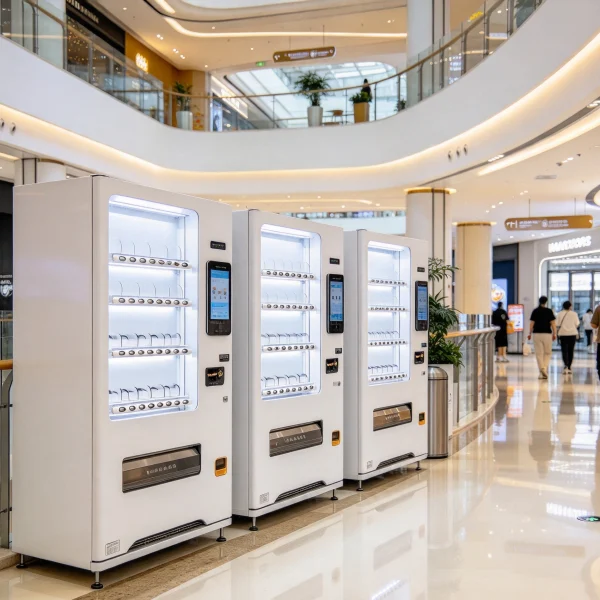
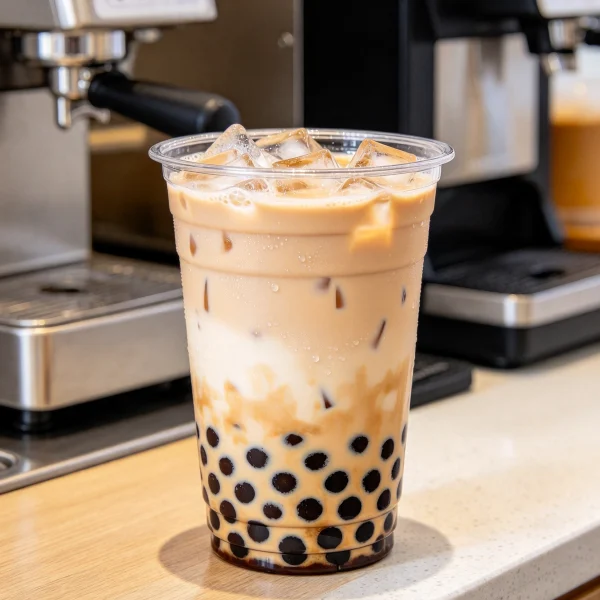
A bubble tea vending machine with touch screen ordering mixes brewed tea, milk, ice, and cooked tapioca pearls into a fresh cup in 45 to 90 seconds. Customers tap through sweetness, ice level, toppings, and cup size on a 15 to 21 inch display, pay by card, QR code, or e-wallet, and watch the cup build behind glass. Shopping malls, university canteens, subway concourses, cinemas, and tea shops that need a self-serve lane at the 3pm rush are the usual homes for these units. Most run on single-phase 220V power, take up 1.2 to 2 square meters of floor, and sell for $9,000 to $25,000 new, with daily output between 150 and 400 cups.
What the touch screen actually controls
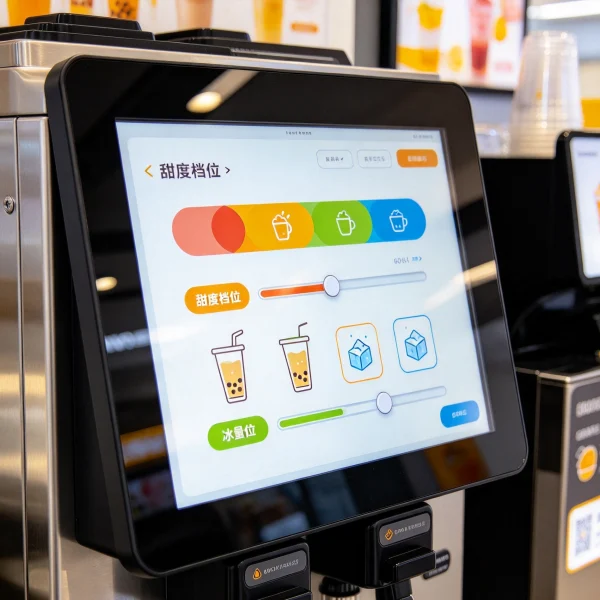
The screen gets the attention. The ordering logic behind it decides whether a queue moves or a crowd of confused customers builds up. A well-built interface walks a first-timer through four choices in under 15 seconds: base tea, milk, sugar level, ice level. Then toppings, then payment.
Machines that hide the no-pearls option three screens deep, or ask for a phone number before payment, create delays exactly when you can least afford them. If you’re buying for a mall location, ask for video of the live order flow rather than a marketing render.
Payment hardware is where cheap machines break
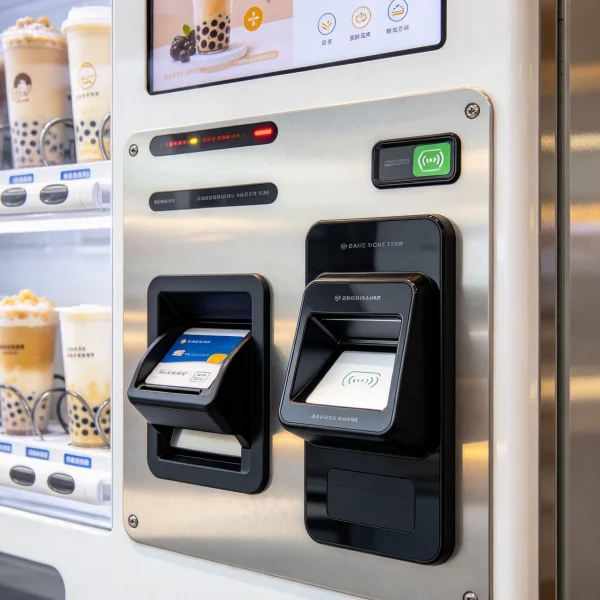
One question comes before every other: does the payment terminal speak MDB? MDB, or Multi-Drop Bus, is the protocol that lets a card reader, coin acceptor, bill validator, and main control board share one wiring loom. When a machine runs a proprietary payment board, replacing a dead card reader in two years means replacing the whole payment stack, and your only supplier is the original factory.
Card and QR terminals from Nayax, Ingenico, and regional e-wallet providers show up on units sold into Singapore, Malaysia, and the Gulf. Cash acceptance still matters in some spots, particularly machines near night markets or bus interchanges.
What a bubble tea vending machine costs in 2026
Price tracks output and build quality far more than screen size does. A 21 inch display adds a few hundred dollars. A second brew tank or a robotic cup handler adds thousands. Here’s roughly how the market splits.
| Machine type | Cups per hour | Footprint | Typical price (USD) | Best for |
|---|---|---|---|---|
| Countertop, manual pearl loading | 40 to 60 | 0.8 to 1.2 m² | $9,000 to $13,000 | Small shops, offices, single-site operators |
| Floor-standing with auto pearl cooker | 80 to 120 | 1.2 to 1.6 m² | $14,000 to $19,000 | Malls, campuses, cinema lobbies |
| High capacity with dual brew tanks | 150 to 200 | 1.6 to 2.0 m² | $20,000 to $25,000 | Airports, transport hubs, multi-unit operators |
Importing direct usually adds 8 to 15 percent for freight, customs, and commissioning on top of the machine price. A local dealer who keeps spare parts on the shelf may charge more upfront and save you a week of downtime later. If you’re weighing this against simpler equipment, our breakdown of how much a drink vending machine costs gives you a useful baseline.
Specs worth checking line by line
Two machines at the same price can carry thousands of dollars of hidden difference. These are the items I’d put in a written spec sheet before asking anyone for a quote.
| Spec | Typical range | Why it matters |
|---|---|---|
| Power supply | 220V single phase, 2.2 to 3.5 kW | Most retail units support it; 3-phase adds wiring cost |
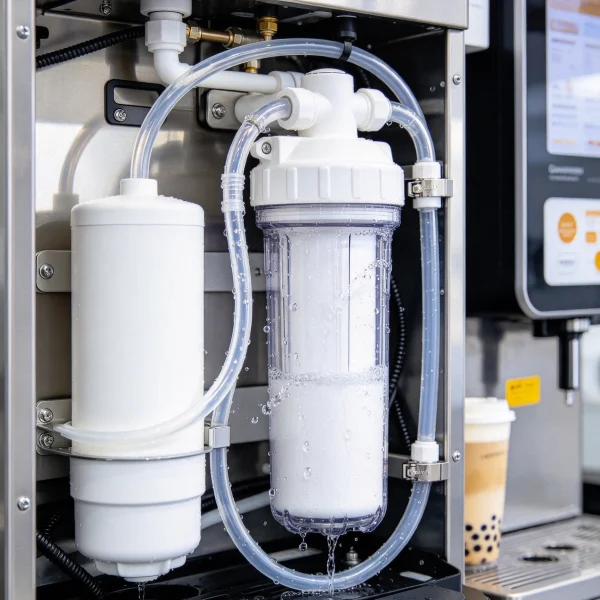
| Water supply | Plumbed 1/4 inch line with filter | Manual tank refills cap you near 80 cups a day |
| Drainage | Gravity drain to floor trap | Without it, staff empty a waste tank several times daily |
| Refrigeration | 2 to 6 °C for milk and tea base | Warm milk is the fastest route to a refund |
| Pearl handling | Cooked in machine or pre-cooked vacuum packs | Pre-cooked pearls cut labour, cost more per cup |
| Cleaning cycle | Automatic rinse, 3 to 8 minutes | Manual teardown adds 30 to 45 minutes of labour |
| Connectivity | Wi-Fi or 4G telemetry | Shows stock levels and faults without a site visit |
Water quality is the item most buyers skip. A machine plumbed into hard water scales its heater and valves within months, and descaling a beverage machine is not a ten-minute job. Budget for a filter cartridge and a replacement schedule from the first day.
Where these machines earn their money
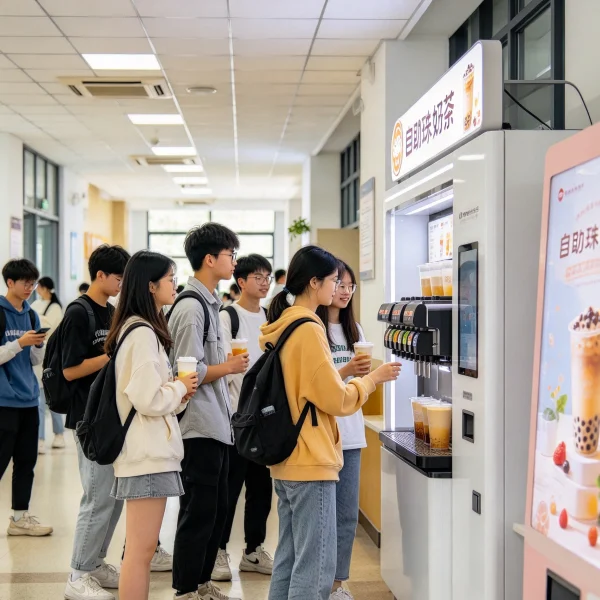
Location decides everything. A unit in a quiet office lobby might do 20 cups a day. The same unit outside a university library during exam week can pass 250.
- Shopping mall concourses, near the food court rather than inside it
- University and polytechnic campuses, close to lecture halls with long breaks between classes
- Cinema lobbies, where the counter queue is worst on Friday and Saturday nights
- MRT and subway interchanges during the morning and evening peaks
- Hospitals, airports, and factory canteens around shift changes
Rent structures differ as much as footfall does. Malls often want a base rent plus a percentage of revenue. Campuses and factories usually charge a flat monthly fee. Run both models before you sign anything.
Running costs and how fast it pays back
Ingredient cost per cup lands between $0.45 and $0.90 depending on whether you use powder, fresh milk, or a blend, and whether pearls are cooked on site. Add the cup, lid, straw, and sleeve and you’re at roughly $0.70 to $1.20 per serve. A mall or campus site typically sells a 16oz cup for $2.80 to $4.50.
Take a $16,000 machine at a campus site selling 80 cups a day at $3.20. Gross margin is around $2.20 a cup, or $176 a day. Subtract power, water, cleaning supplies, and the location fee, call it $60 a day, and you’re near $116 net daily, roughly $3,000 a month over 26 trading days. That points to payback in the 5 to 7 month range. Strong sites land closer to 4 months, slower ones stretch toward 9, which is why the site survey matters more than the spec sheet. Our 2026 analysis of whether vending machines are still a good investment runs the same math for other machine types.
Who buys these machines
Buyers tend to fall into four groups. Independent tea shop owners want a self-serve lane for peak hours. Mall operators want a dead corner earning rent. Food service contractors supplying campuses, hospitals, and factories want a 24-hour revenue line with no staff on site. Multi-unit vending operators want a higher-ticket product alongside their snack and drink routes. That last group usually buys three or four units once the first one proves out, and the buying pattern looks a lot like what we see with other kiosk categories.
How to vet a supplier before you wire money
This is where first-time buyers lose money. The machine is half the purchase. The other half is whether anyone picks up the phone when a pearl dispenser jams at 9pm on a Saturday.
- Ask for three installed references in your country and actually call them
- Get the spare parts list in writing, with prices for pumps, valves, heaters, and screens
- Confirm warranty length (12 to 24 months is normal) and what it excludes
- Ask what the response time is and who pays the technician’s travel
- Check that pearl cookers, o-rings, and cup dispensers are stocked locally
Comparing suppliers is the part most buyers rush. On VendingCore you can compare verified suppliers side by side, read real buyer reviews, check price ranges, and send an inquiry directly instead of emailing ten factories and waiting a week for two replies.
Five mistakes first-time buyers make
- Buying on screen size. A 21 inch display looks impressive and changes nothing about taste, speed, or reliability.
- Skipping the site survey. Footfall at 3pm on a Tuesday tells you more than a mall’s annual visitor count.
- Choosing the cheapest quote. Rock-bottom prices usually mean proprietary boards and no local spare parts.
- Forgetting consumables logistics. Pearls, syrups, and cups need shelf space and a reorder rhythm. Almost nobody plans that.
- Ignoring power and drainage. A unit that needs 3-phase power or a new floor trap can push your opening back weeks.
What to do next
Get the specification right first, then the supplier. Write down your expected daily cups, your power and water situation, and whether you want pearls cooked on site. Send that one-page brief to three or four suppliers and compare what comes back. On VendingCore you can compare verified suppliers, read reviews from operators who already run these machines, check price ranges, and submit an inquiry directly to the ones that fit.
The machine is a known quantity at this point. What separates a profitable unit from an expensive piece of furniture is the site, the service contract, and how fast someone answers when the syrup pump fails.
FAQ
How much does a bubble tea vending machine with a touch screen cost?
New units run from about $9,000 for a countertop model to $25,000 for a high-capacity floor unit with dual brew tanks. Screen size adds only a few hundred dollars. Capacity, refrigeration, and automatic pearl cooking drive the real difference. Importing direct adds 8 to 15 percent for freight, customs, and commissioning. Always compare the delivered and installed price, not the ex-works figure.
How long does one cup take to make?
Most machines finish a 16oz cup in 45 to 90 seconds, and the pearl dispensing step is usually the slowest part. During a rush, per-cup time matters less than payment speed and how quickly the interface moves people through. Ask a supplier for peak-throughput data, not an average taken on a quiet morning.
Does it need a plumbed water line and a drain?
Floor-standing units almost always do. They expect a 1/4 inch filtered water line and a gravity drain to a floor trap. Countertop models with internal tanks exist, but a tank caps you somewhere near 60 to 80 cups a day and someone has to refill and empty it. If you’re chasing real volume, plumbing is not optional.
Are the tapioca pearls cooked inside the machine?
Both approaches are common. Some machines cook pearls on a timed cycle of roughly 30 to 45 minutes; others warm vacuum-packed pre-cooked pearls in a hopper. Cooked-in-machine pearls cost less per cup and taste fresher, but they add cleaning work. Pre-cooked pearls cut labour and waste and cost more per serve.
How many cups a day do I need to make it worthwhile?
Most operators target 70 to 120 cups a day. Below about 50, a machine rarely covers its rent and power, no matter how cheap it was. At 80 cups a day with an average cup price near $3, payback typically falls between 5 and 7 months. Run the numbers for your own location before you commit to a lease.
Do I need a licence to operate one?
It depends where you are. Most jurisdictions want a food handling licence, landlord approval for the tenancy, electrical certification for the connection, and periodic hygiene inspections. In Singapore specifically, our guide to owning a vending machine in Singapore walks through the licences and setup costs. Confirm requirements with the local authority before you order.
What should I ask a supplier for before paying a deposit?
Three installed references you can call, a spare parts price list, written warranty terms, a stated response time for breakdowns, operator training, and confirmation that the payment terminal runs on MDB. If a supplier resists putting any of that in writing, that tells you what service will look like after the invoice is paid.
Can I add one to a restaurant or cafe?
Plenty of outlets do, mostly to capture the afternoon lull when kitchen staff are idle and foot traffic still passes the door. The planning logic is the same as any other kitchen addition: power load, floor space, drainage, and staff workflow. Our guide to equipment planning for food outlets covers how that trade-off usually plays out.
The machine is the easy part. What separates a site doing 250 cups a day from one doing 20 is foot traffic timing and dwell time. No screen fixes a bad location, and no discount makes up for a supplier who can’t deliver a forty-dollar valve in three days. Before you sign, ask what happens at 9pm on a Saturday when the pearl hopper runs dry. If the answer is a helpline in another time zone, keep looking.