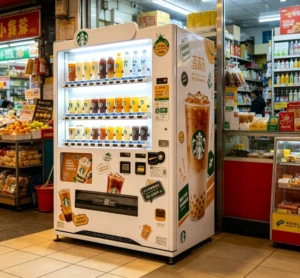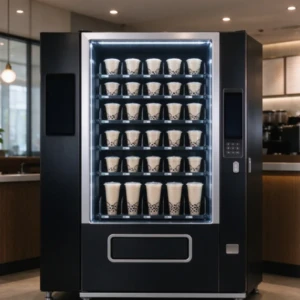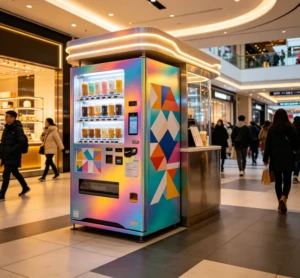
Bubble tea vending machine manufacturers build automated kiosks that brew tea, mix milk and ice, drop tapioca pearls into the cup, and seal a fresh serving in 45 to 90 seconds. You’ll see them in mall food courts, university canteens, subway concourses, hospital lobbies, and storefronts where a staffed boba shop can’t justify a night shift. The machine carries a tea brewer, a syrup bank, an ice hopper, a heated pearl holder, a cup dispenser, and a sealing head, and it runs on 220V single-phase power with a water line. Most buyers shortlist three to five suppliers, then compare cups per hour, pearl capacity, and who stocks cups and pearls in their city.
What a fresh bubble tea machine makes, and what it doesn’t
A bubble tea vending machine is a beverage maker, not a glass-door cabinet full of sealed bottles. Inside you’ll find a tea brewer or concentrate dosing pump, a milk or creamer line, four to eight syrup channels, an ice hopper, a heated tapioca pearl holder, a cup dispenser, and a sealing head. A customer picks a flavor, sets sweetness and ice on the touchscreen, pays, and the machine assembles the drink while they watch.
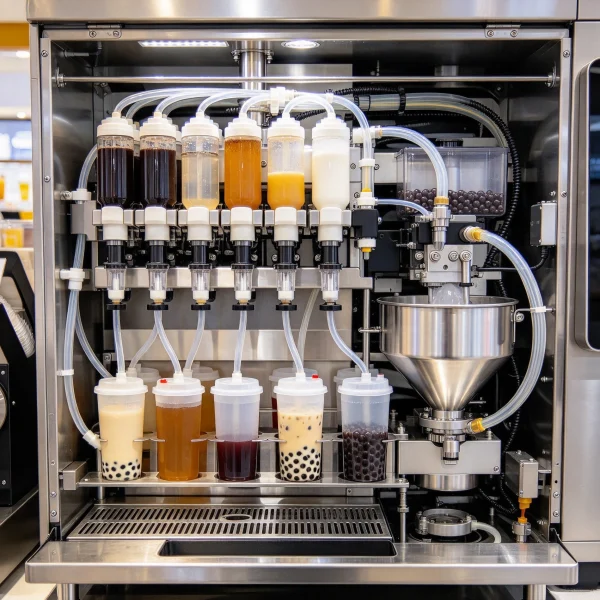
That distinction decides your whole business model. A packaged drink machine costs a third as much and barely needs cleaning, but you end up selling the same bottled milk tea as the convenience store on the corner. A fresh-dispense unit gives you pearl texture and a warm cup at the seal, which is the same reason smart coffee vendors that grind and brew on demand still pull a line at 8 a.m.
Pearl texture decides whether customers come back
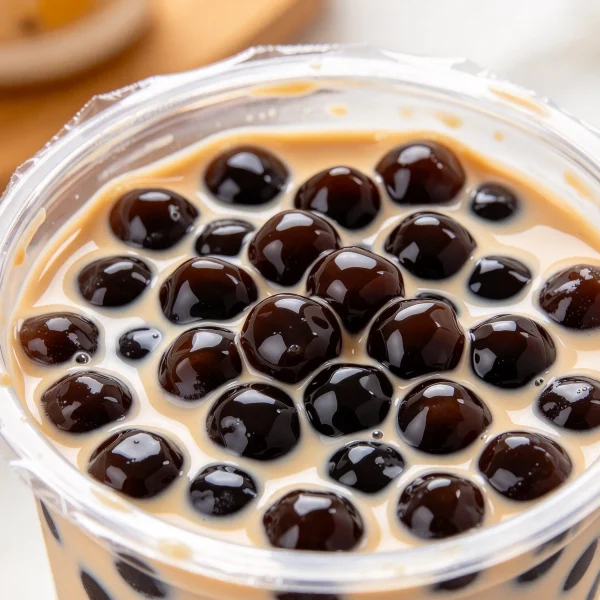
Tapioca pearls are the hardest part of this business. Cooked pearls keep their chew for three to four hours in a warm sugar bath before they firm up into little stones, which is why staffed shops dump trays all afternoon. A machine handles it with a heated hopper that holds pearls at 55°C to 65°C in water and doses them per cup, so the batch turns over with sales instead of sitting all day.
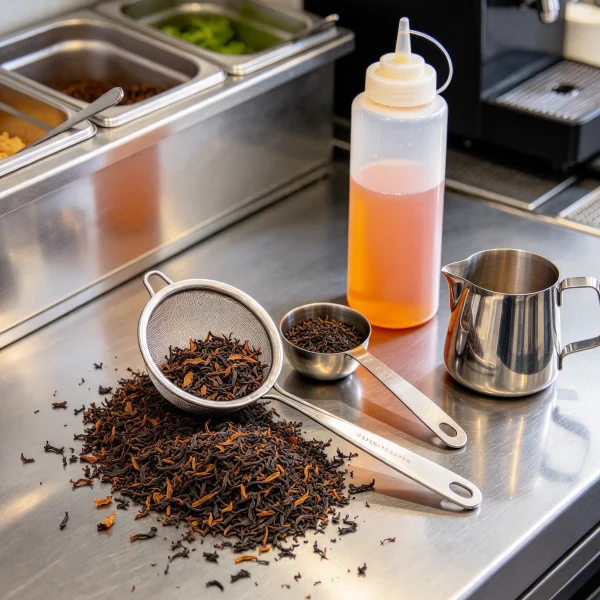
Cheap units skip the water bath and keep pearls warm and dry. Those go gummy by lunch. When you compare quotes, ask what temperature the pearl hopper holds, how often it needs cleaning, and how many cups one loading covers. A supplier who answers with numbers has built these before.
How to vet bubble tea vending machine manufacturers
Most suppliers in this niche fall into three groups. OEM factories build the cabinet, the brewer, and the dosing hardware themselves. Integrators buy a base unit and add their own software, screen, and payment stack. Trading companies rebrand someone else’s machine and add 20% to 35% on top. None of those is automatically a bad choice, but you need to know which one is answering your emails, because it changes who fixes the machine in month nine.
VendingCore is built for this exact step. On VendingCore you can compare verified suppliers, read reviews from buyers who already run the machines, check price ranges, and send an inquiry directly, which beats collecting WhatsApp numbers at a trade show. Three questions sort the serious ones from the resellers: which parts do you manufacture in-house, can you send the wiring diagram and a priced spare parts list, and who services this machine in my city?
Recipe control and brewing
Loose-leaf brewing gives better flavor and needs a cleaning cycle plus a water filter. Concentrate is cheaper to run and simpler to maintain. Ask about syrup dosing accuracy, since a 2 ml drift is the difference between a repeat customer and a refund. Also ask whether recipes can be locked so staff can’t quietly change the sweetness calibration.
Payments and telemetry
Insist on MDB protocol support, a card reader that works with your local acquirer, and the QR payment your market actually uses, whether that’s Alipay, UPI, PromptPay, or Pix. Then check the telemetry: sales reports, temperature alerts, and low-stock warnings pushed over 4G or WiFi. If a machine can’t tell you the pearl hopper is nearly empty before a customer does, you’ll lose sales you never see.
Spare parts and service
Seals, peristaltic pump tubes, cup dispensers, and pearl augers wear out. A sealer gasket costs a couple of dollars and stops the whole machine when it fails. Get a spare parts price list with lead times in writing, and ask whether a parts kit ships with the first order. Then find out which technician in your area has actually opened one of these units.
What suppliers quote in 2026
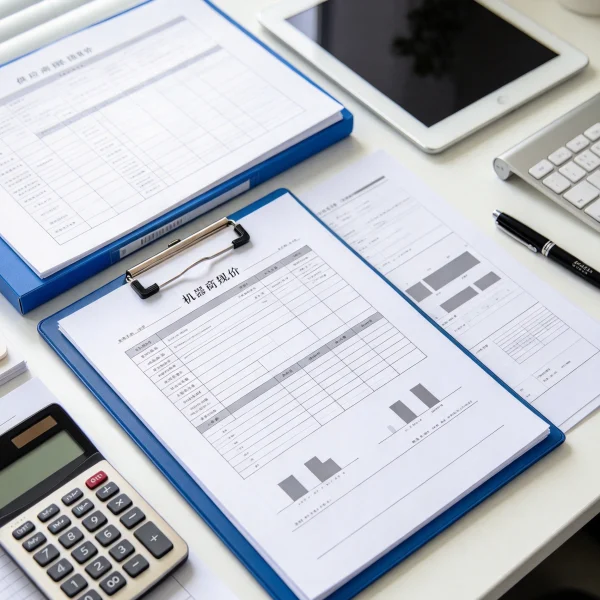
Quotes for fresh-dispense units usually land in three bands, and everything below assumes a pearl hopper, sealed cup output, card and QR payment, and remote telemetry. Freight, duties, water filtration, and installation sit on top, adding roughly $400 to $1,500 depending on where you are. If two quotes are 40% apart, they’re almost never the same machine underneath.
| Machine class | Cups per hour | Cup and pearl capacity | Typical quote (USD) | Best fit |
|---|---|---|---|---|
| Compact countertop | 30-50 | 80 cups, 3 kg pearls | $5,500 – $9,000 | Offices, small cafés, clinics |
| Mid-range freestanding | 60-90 | 150 cups, 5 kg pearls | $9,000 – $16,000 | Mall corridors, campuses |
| High-output dual boiler | 100-150 | 300 cups, 8 kg pearls | $16,000 – $28,000 | Transit hubs, food courts |
Notice that the jump from compact to high-output is mostly about the ice system, the number of syrup channels, and how many cups the dispenser holds before someone refills it. A machine that runs out of cups at 2 p.m. on a Saturday costs you more than the price difference.
Separating a real manufacturer from a trading company
Anyone can send you a polished catalog. Fewer can send a wiring diagram, a parts list, and a customer in your city who’ll take a phone call. Use the checklist below as a filter before you talk price.
| What to check | Strong answer | Warning sign |
|---|---|---|
| Factory verification | Live video tour of the assembly and QC stations | Stock photos or an office called a showroom |
| Certification | CE, UL, or ETL papers showing your exact model number | Generic certificates for a different unit |
| Spare parts | Priced list with part numbers and lead times | We will send parts if you need them |
| Software and dashboard | Your own login, sales data you can export | Screenshots with another company’s logo |
| Reference sites | Two or three operators in your region who will talk | City names with no contact details |
| Warranty terms | 12 to 24 months on parts, labor terms spelled out | Warranty void the moment you open the cabinet |
Then ask for two reference sites in your region, and actually call them. Operators are blunt about downtime, and one honest five-minute conversation beats an hour of catalog reading.
If vending is new to you, spend an afternoon on how operators think about placement and margins before you talk to any boba supplier. The economics of starting a vending machine business and the real cost of buying machines apply here too, just with a higher price per cup.
Location and payback math
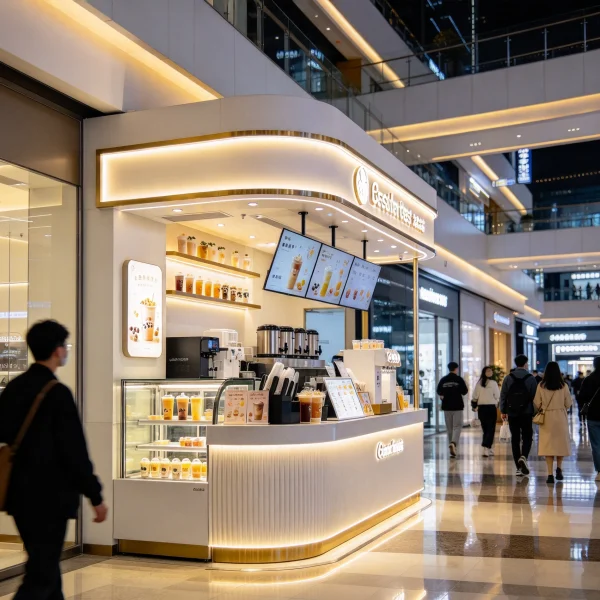
Machines rarely fail because of the machine. They fail because of the spot. A boba unit needs foot traffic plus a reason for people to pause, so a university canteen at lunch is worth more than an office lobby with 200 employees. Food courts and transit concourses deliver volume with higher rent. Hospitals and campuses give steadier daily numbers with less seasonality.
Ingredient cost per cup runs about $0.45 to $0.80 once you add tea, milk or creamer, syrup, pearls, cup, lid, and seal. Sell at $3.50 to $5.50 and you keep roughly $2.50 to $4.50 gross before rent, power, and payment fees of 1.5% to 3%. At 100 cups a day that’s around $250 in gross margin daily. A well-placed machine typically pays for itself in 6 to 9 months, and prime spots with 200 or more cups a day can do it in 4 to 6. A weak spot pushes you to the far end of that range, and no discount on the cabinet fixes it.
The same traffic math drives other unattended kiosks, from a custom puzzle vending machine in a tourist area to simpler routes, where toy vending profitability depends on the same question of who walks past and how often.
Buyers ask me which brand is best, and that’s the wrong first question. Ask what happens on a Saturday afternoon when the sealer jams and forty people are standing in line. The suppliers who earn repeat business are the ones who ship a spare parts kit with the machine, publish a parts list with prices, and have a technician within a two-hour drive. The recipe and the touchscreen get all the attention, but uptime is what you’re really buying. Get the service answer in writing before you wire the deposit, because nobody remembers the fancy screen when the machine is dark.
Before you send your first inquiry
Write your spec down first: cups per hour you need, available floor space, whether you have a water line and drain, payment methods in your market, screen language, and who will service the unit. Send that same list to three or four suppliers so the quotes stay comparable. On VendingCore you can compare verified suppliers side by side, read reviews from operators already running them, and submit an inquiry directly from each listing. Ten minutes of comparing beats three weeks waiting on a single reply.
FAQ
How much does a bubble tea vending machine cost in 2026?
Compact units start around $5,500 to $9,000, mid-range freestanding machines run $9,000 to $16,000, and high-output dual-boiler units reach $28,000. Add roughly $400 to $1,500 for freight, duties, water filtration, and setup. Fresh-dispense machines cost more than bottled drink vendors because of the brewer, ice system, pearl hopper, and sealing head. Always request a quote that includes a spare parts kit so you can compare total cost rather than sticker price.
What is the difference between a fresh bubble tea machine and a bottled drink machine?
A fresh bubble tea machine brews or doses tea, adds milk, syrup, and ice, heats tapioca pearls, and seals the cup on the spot. A bottled drink machine drops pre-packaged bottles through a coil and needs no water connection at all. Fresh units produce 30 to 150 cups per hour and require daily cleaning of the pearl hopper and drip tray. Margins are usually higher on fresh drinks because you aren’t paying a bottler’s wholesale price per unit.
How long does it take to make one cup?
Most machines finish a cup in 45 to 90 seconds, including the pearl drop and the seal. Pearl dispensing, ice making, and sealing are the slow steps, so ask whether the unit can ice and brew in parallel while the previous cup is sealing. At a busy counter that difference decides whether you serve 60 cups an hour or 110, which matters far more than a five-second difference in screen loading time.
Do bubble tea vending machines need a water line and drain?
Most freestanding units need a 1/4 inch water inlet, a drain, and a filter. Some compact countertop models carry a refillable tank of roughly 20 to 30 liters instead, which suits offices and pop-up sites where plumbing isn’t available. Without drainage, cleaning the drip tray and waste bin becomes a messy daily chore, and leftover moisture around the machine shortens the life of the electronics.
How do I find reliable bubble tea vending machine manufacturers?
Ask every candidate for a live factory video, a priced spare parts list, CE or UL documents matching your exact model number, and two operators in your region who will take a call. Suppliers split into OEM factories, integrators, and trading companies, and the service you get differs sharply between them. On VendingCore you can compare verified suppliers side by side, read buyer reviews, check price ranges, and send inquiries to several at once rather than chasing one vendor for weeks.
How much profit does one cup make?
Ingredient cost lands around $0.45 to $0.80 per cup for tea, milk or creamer, syrup, pearls, cup, lid, and seal. Sell at $3.50 to $5.50 and the gross margin is roughly $2.50 to $4.50 before rent, power, and payment processing fees of 1.5% to 3%. At 100 cups a day, that’s about $250 in gross margin daily. Pearl waste and spoilage are the two costs new operators underestimate most.
Do I need staff to run a bubble tea vending machine?
Usually not for serving. The machine handles ordering and payment, so someone only needs to clean it once or twice a day, refill pearls, cups, syrup, and milk powder, and empty the waste bin. One part-time person can cover three to five machines on a route. Remote telemetry matters here, because low-stock and temperature alerts let you plan refills instead of driving out to check.
How long until the machine pays for itself?
Most well-placed units in 2026 pay back in 6 to 9 months. Prime locations serving 200 or more cups a day can reach payback in 4 to 6 months. The variables are rent, cups per day, and your selling price, not the brand on the cabinet. Two machines bought at the same price can differ by four months purely because of where they sit.