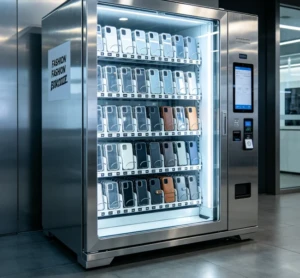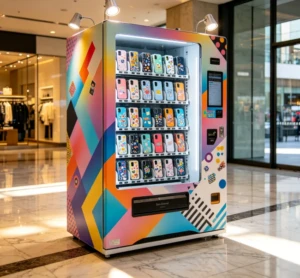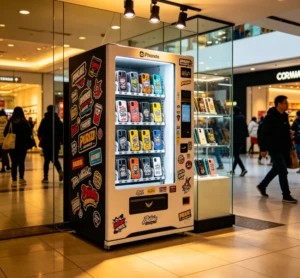
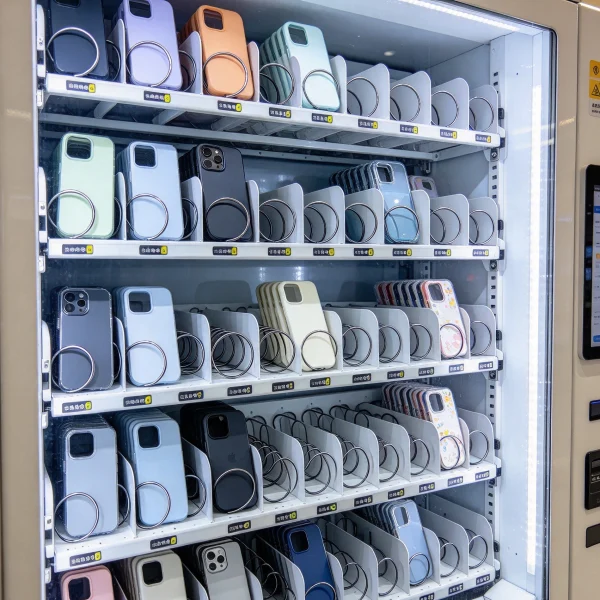
How much profit does a phone case vending machine make? Most operators land between $400 and $1,500 a month in net profit after case cost, location fees, card processing, and their own restocking time. The machine holds pre-made cases sorted by phone model, lets a buyer tap their model on a touchscreen and pay by card or QR code, then drops the matching case into the chute. You’ll find them in mall corridors, airports, gyms, subway stations, university buildings, and outside phone repair shops. A typical unit stands 1.8 to 2.2 meters tall and plugs into a normal wall outlet.
What one of these machines really earns
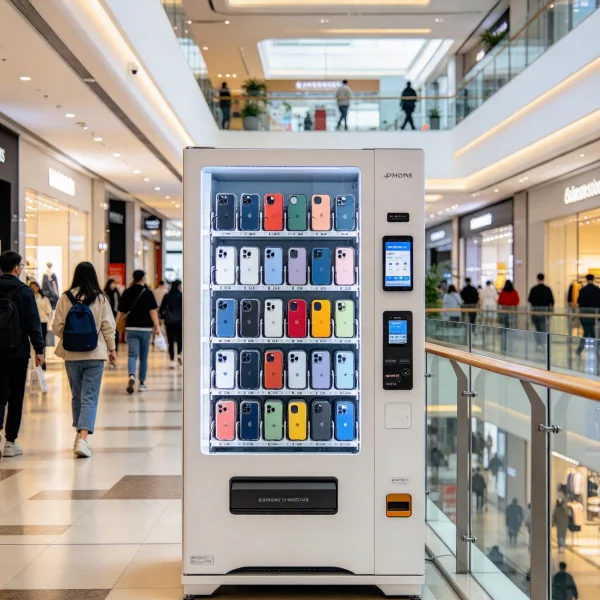
A phone case vending machine is a glass-front kiosk that stocks pre-made cases by phone model and dispenses the right one once the buyer selects their device and pays. That simplicity is exactly why the profit question has such a wide answer. Ask ten operators and you’ll get ten different numbers, because the machine is only half the story. The other half is where it sits and what that spot costs you every month.
| Placement | Cases per day | Average price | Monthly gross | Monthly costs | Monthly net | Payback |
|---|---|---|---|---|---|---|
| Gym or salon lobby, 30-slot unit | 2 | $14 | $840 | $440 | $400 | About 7 months |
| Mall corridor near a food court | 4 | $15 | $1,800 | $1,030 | $770 | About 6 months |
| Airport or transit hub | 7 | $17 | $3,570 | $2,020 | $1,550 | About 4 to 5 months |
Look at the spread. Same hardware, same wholesale supplier, three very different outcomes. The airport unit clears almost four times what the gym unit does, mostly because it sells more than three times as many cases and charges a few dollars more for each one. Location is the lever that moves your income the most.
The per-case math, from wholesale to payout
Monthly profit is cases sold multiplied by margin per case, minus your fixed costs. Only two of those numbers are genuinely in your control before you buy: the wholesale price you pay and the retail price you set.
What you pay for a case
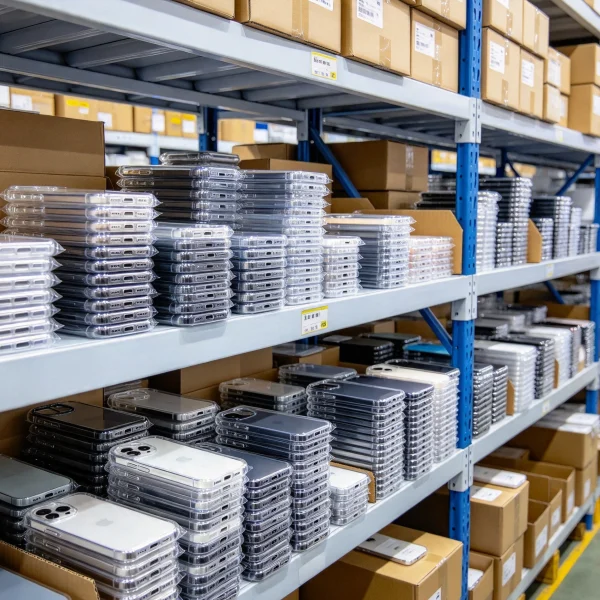
Wholesale cases run about $1.80 for a plain clear TPU model and up to $4.50 for MagSafe-compatible or printed designs, depending on order volume and how many models you buy at once. A workable rule is keeping case cost under 25% of your retail price. Buy at $3 and sell at $15 and you’re at 20%, which leaves room for rent and card fees. Order mixed model packs rather than one model at a time; single-model orders push your unit cost up and leave you holding dead stock.
Costs that quietly eat the margin
Card processing takes roughly 2.6% plus $0.10 per transaction, so a $15 sale costs you about 49 cents. A mall or transit location fee runs $450 to $900 a month, usually billed as a flat fee or a 15% to 25% cut of sales. Then there’s dead stock. Cases for a phone model nobody in that building owns sit in the machine forever. Restocking and cleaning take one to two hours a week, and if you pay someone to do it, that’s real money leaving your pocket.
Why location beats every feature on the machine
I’ve watched operators spend an extra $2,000 on a bigger touchscreen and then park the unit in a hallway nobody walks down. Traffic converts to profit, and a few things make a spot worth paying for:
- People who are stuck somewhere for a while: airport gates, transit platforms, cinema lobbies, laundromats.
- People whose phone is already broken: outside repair shops and mall service kiosks. A cracked screen is the best salesperson you’ll ever have.
- Captive audiences with no cheap alternative nearby: gyms, hospitals, university libraries, staff canteens.
- Buildings where the same phone models repeat: offices full of company-issued devices, schools, sports clubs.
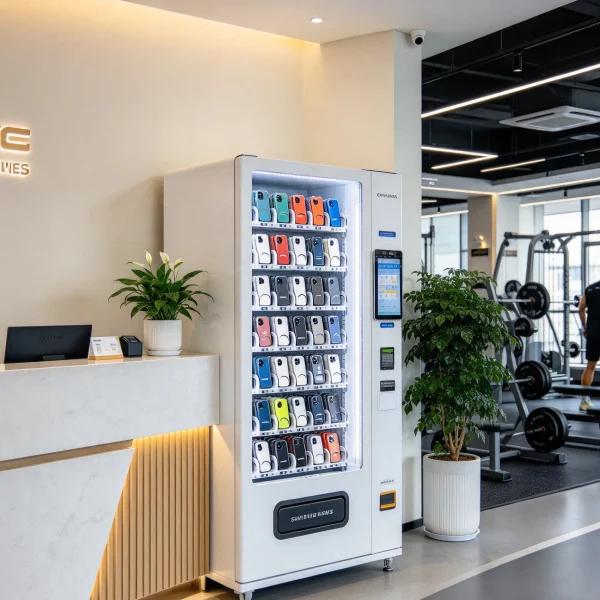
Rent should stay under 25% of gross sales. If a landlord wants $900 a month and your realistic gross is $1,800, walk away and find the $400 spot turning $1,200 instead. The percentage matters more than the absolute fee.
How many cases a day do you need to break even?
The formula is simple: monthly fixed costs divided by margin per case. Say your location fee, processing, and labor come to $600 a month and you clear $12 per case. That’s 50 cases a month, or under two a day. Most decent spots sell two to seven a day, which is why payback periods sit in the single digits instead of stretching out for years.
The trap is fixed costs that scale with your sales. A revenue-share deal at 25% means every extra case hands a quarter of the margin to the landlord. Flat fees protect you in busy locations; revenue share protects you in quiet ones. Pick based on an honest traffic estimate, not on whichever contract sounds friendlier.
Specs that actually change your profit
Slot count decides how often you restock and how many phone models you can carry. Carry too few models and buyers walk away because their phone isn’t listed. Carry too many and you tie up cash in stock that never moves.
| Machine size | Slots | Screen | Typical price | Where it works |
|---|---|---|---|---|
| Compact | 30 to 40 | 7-inch | $2,500 to $3,800 | Gyms, salons, repair shops |
| Mid-size | 60 to 80 | 15.6-inch touchscreen | $3,800 to $5,500 | Malls, cinemas, campuses |
| Large with MDB controller | 100 to 150 | 21.5-inch touchscreen | $5,500 to $8,000 | Airports, transit hubs, stadiums |
If you’re still comparing hardware, the phone case vending machine category page breaks down slot counts, screen sizes, and price bands by supplier. For a small venue, 30 to 40 slots is plenty. For an airport unit selling seven cases a day, you want 100 slots or more so one restock covers a full week.
Payment and telemetry matter more than the cabinet finish
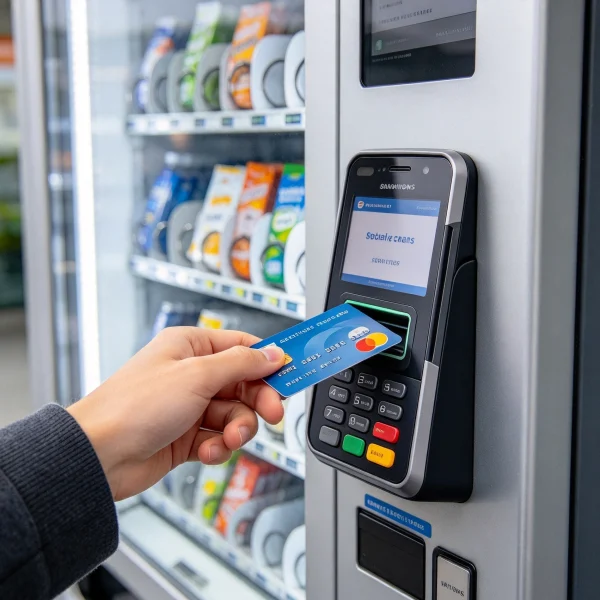
Look for an MDB controller, because that standard lets you swap card readers later without replacing the board. NFC tap and QR payment should both be on the reader; younger buyers reach for their phone before their wallet. DEX or cloud telemetry reports stock levels remotely, which turns a two-hour weekly route into a twenty-minute one. That saved time is profit you don’t have to sell a single case to earn.
Mistakes that turn a $700 machine into a $200 machine
Most underperforming units fail for boring, avoidable reasons:
- Stocking only the newest iPhone models and ignoring the mid-range Android phones that dominate many buildings.
- Letting the machine run empty for a week. Buyers don’t come back after two failed visits.
- Setting prices too low to look competitive. A $13 case sells nearly as well as a $9 case and earns $4 more.
- Choosing a model without a card reader. Cash-only machines lose the impulse buyer who carries no notes.
- Signing a lease before testing traffic in person.
How to check a supplier before you wire money
Machine quality varies far more than spec sheets admit. Ask any supplier for the real power draw, the warranty term on the dispensing mechanism, and whether they keep spare parts in your country. Spare parts decide whether a breakdown costs you two days or six weeks. Buying from overseas? Read up on whether Chinese vending machines are reliable before you compare quotes, because the answer depends heavily on the factory and the importer standing behind it.
Then verify the numbers yourself. Ask for two reference customers in your region and actually call them. It also helps to understand the daily routine first, since how a phone case vending machine works in practice decides how much of your profit survives contact with reality.
What to do next
Run the math for your own location before you buy anything. Estimate cases per day, set a realistic price, then subtract case cost, rent, processing, and your own time. If the total lands under $250 a month in a spot you can’t fix, find another spot.
Then collect quotes from several factories. Prices for the same slot count and screen size can differ by 30% or more, and so can the warranty behind them. Machine type shifts the numbers too; a look at how profitable a popcorn machine is shows how widely net margins move between vending categories. Operators who later add a burger vending machine to a food court usually reuse the location contacts they already built.
VendingCore is the shortcut here. It’s a supplier directory, not a manufacturer, so you compare verified suppliers side by side, read real buyer reviews, check price ranges, and send an inquiry straight to the factories that fit your budget. Start with the phone case listings, shortlist three suppliers, and ask each one the same five questions about warranty, spare parts, payment protocol, lead time, and references. That’s how you learn what your machine will actually earn before the money leaves your account.
FAQ
How much profit does one phone case vending machine make per month?
Most units net $250 to $1,500 a month after case cost, location fees, card processing, and labor. A low-traffic spot in a gym or salon sits at the bottom of that range, around $250 to $400. A busy mall, airport, or transit location can clear $700 to $1,500. The machine model matters less than the number of cases sold per day and the fee you pay for the space.
What is the profit margin on a single phone case?
A case bought wholesale at $1.80 to $4 and sold at $12 to $25 leaves a gross margin of roughly $9 to $20 per unit, or 70% to 80% of the retail price. Rent, card fees, and restocking pull the net margin down to somewhere between 40% and 60% once the machine runs in a paid location.
How much does a phone case vending machine cost?
A compact 30 to 40 slot unit with a card reader typically costs $2,500 to $3,800. A mid-size 60 to 80 slot machine with a 15.6-inch touchscreen runs $3,800 to $5,500. Large models with 100 slots or more, an MDB controller, and a 21.5-inch screen sit between $5,500 and $8,000. Budget another $500 to $1,500 for your first case inventory.
Where should I place it for the best profit?
Places with waiting people and few alternatives perform best: airport gates, transit platforms, mall corridors near food courts, cinema lobbies, gyms, hospitals, and university buildings. A spot outside a phone repair shop is especially strong because customers show up with a broken device. Keep rent under 25% of gross sales, and test traffic in person before you sign anything.
How long until the machine pays for itself?
In a location selling three to seven cases a day, payback usually lands between four and nine months. The faster end comes from high-traffic spots with flat monthly fees. If a machine isn’t covering its own rent within the first 90 days, move it rather than waiting, because weak locations rarely turn around on their own.
Do I need a permit or license to run one?
Requirements vary by country and city. Many places need a general business license and sales tax registration, and some malls or airports ask for liability insurance plus a signed vending agreement. Check with your local business authority before ordering the machine, and confirm who handles sales tax on card transactions, since your payment processor may collect and remit it on your behalf.
How do I find a reliable supplier?
Compare at least three factories on price, warranty length, spare parts availability in your country, and response time. Ask for two reference customers in your region and call them. On VendingCore you can compare verified suppliers, read buyer reviews, check price ranges, and send an inquiry directly, which shortens the gap between shortlisting and getting a real quote.
I’ve run phone case machines for six years, and the biggest mistake I see is people buying a machine before they have a location. The machine is the easy part. What you’re really buying is the right to sell inside a specific building, so figure out who walks past that spot and what phone they carry. Stock for the phones that are actually in the building, not the ones in the launch reviews. Restock before you think you need to. And review model-level sales every month, because a case that hasn’t sold in 90 days is money sitting still inside the cabinet.