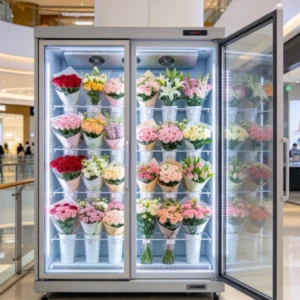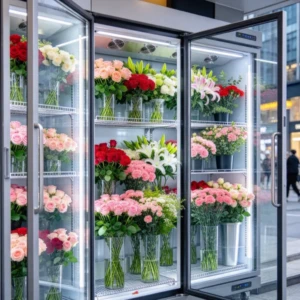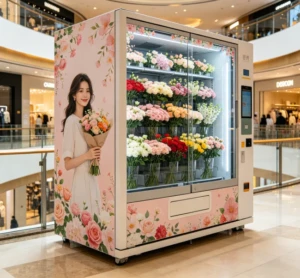
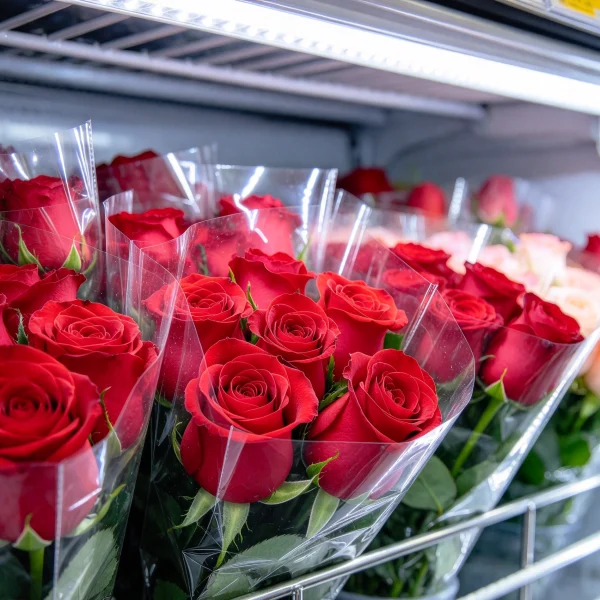
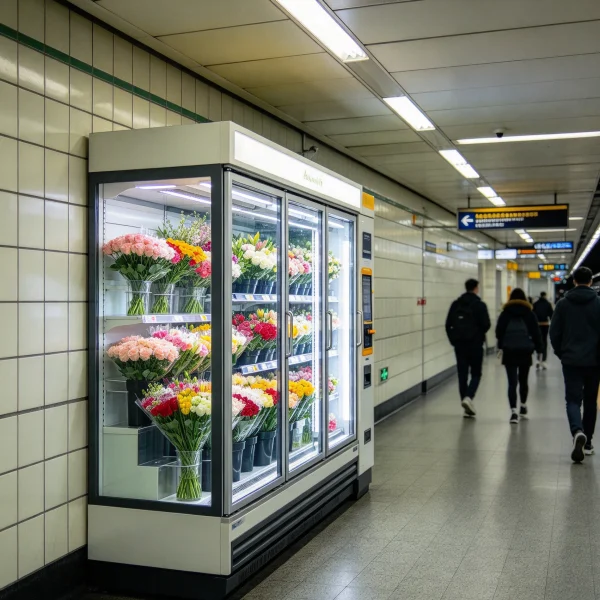
A flower vending machine is a refrigerated kiosk that dispenses fresh bouquets or single stems from a chilled display case, usually holding 20 to 40 bouquets at 2 to 8°C (36 to 46°F). You’ll find them outside hospitals, on metro platforms, in hotel lobbies and beside cemeteries, wherever someone needs flowers at 11pm and every florist has closed. Most units run on standard 110V or 220V power, accept card and QR payments through an MDB controller, and take up about two square meters of floor space. Single wrapped stems sell for $3 to $6; full arrangements go for $15 to $45.
What’s actually inside the cabinet
Strip away the glass and the LED strips and you’re looking at a small commercial refrigerator with a selling mechanism bolted on. Everything else is detail.
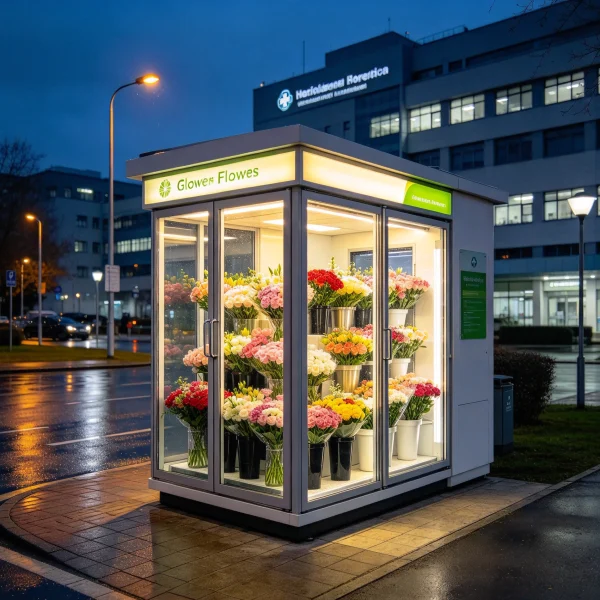
The refrigeration side matters more than the retail side. A decent unit holds 2 to 8°C with humidity near 80 to 90%, roughly what a florist’s walk-in cooler does. Cheaper cabinets cool the air and dry it out, and dry air pulls water from petals within a day. If the spec sheet lists no compressor brand and no humidity figure, ask for both in writing before you compare anything else.
Dispensing usually takes one of three forms:
- Individual lockers. Each bouquet sits behind its own magnetic door. Simple to repair, and customers see exactly what they’re buying.
- A carousel. Numbered slots rotate to a pickup window. Fits more product per square meter, and adds a motor and a position sensor to your maintenance list.
- A pick arm. A gripper lifts the bouquet and moves it to the delivery slot. Good for premium arrangements and longer stems, with more that can break.
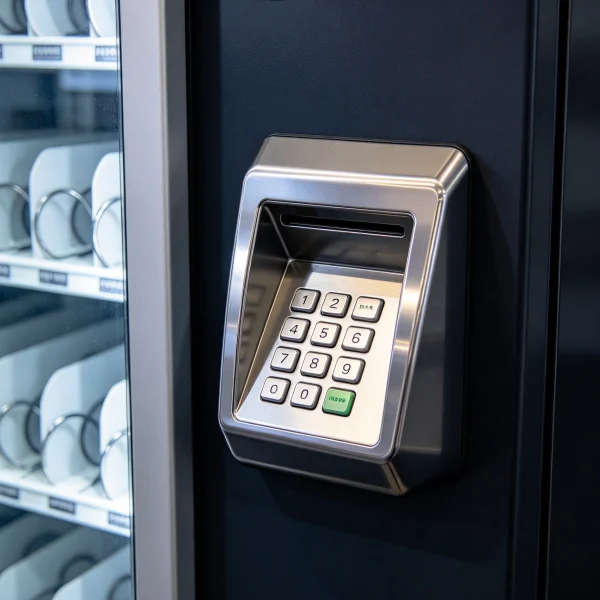
Payment runs on MDB, the same protocol used in drink and snack machines, so most card readers and QR terminals drop straight in. What you really want on top of that is telemetry: a 4G module that messages you when the case drifts warm or a slot sells out. Without it, you’re driving to site just to find out.
Typical prices in 2026
Compressor and card-reader costs climbed through 2024 and 2025 and haven’t come back down. Here’s roughly what buyers are quoted now, based on supplier listings and quotes operators share on VendingCore.
| Machine type | Capacity | Price range (USD) | Best for |
|---|---|---|---|
| Single-stem cup unit | 18 to 30 cups | $3,800 to $6,500 | Impulse buys, tight footprints, 110V sites |
| Bouquet carousel | 18 to 28 bouquets | $6,000 to $11,000 | The workhorse for hospital and metro sites |
| Locker-style refrigerated case | 30 to 48 lockers | $9,500 to $18,000 | High volume, wider product range |
| Custom branded premium unit | 12 to 24 slots | $15,000 to $32,000 | Florist storefronts, event venues, gifting |
Those figures cover the machine only. Delivery, installation and card reader activation usually add 8% to 15%, and a site with no usable power nearby can cost more once an electrician gets involved. If you’re pricing a one-off build rather than a catalogue unit, this breakdown of how much a custom vending machine costs shows where the money actually lands.
Where these machines actually earn
Foot traffic on its own won’t carry a unit. Flowers are a mood purchase, and the mood usually comes from an occasion or an inconvenience.
- Hospital entrances. Visitors arrive without a gift and the gift shop shut hours ago.
- Metro and rail platforms. Commuters heading home empty-handed on an anniversary they forgot.
- Cemeteries and crematoria. Steady, unemotional demand seven days a week.
- Hotel lobbies. Concierge traffic, guests who need something at short notice.
- Wedding and event venues. Late-night replacements and guests who forgot to bring anything.
- University campuses. Exam weeks and graduation weekends spike hard.
A hospital lobby is the classic first site for a reason. The audience is captive, the occasions are constant, and a reception desk will happily send someone twenty metres down the corridor. Stand in the spot for three days before you sign anything and count how many people walk past after 8pm. That number tells you more than any demographics report.
Some operators pair a floral case with a novelty unit in the same lobby to widen the age range of buyers. If that’s your plan, it helps to know what a lucky box vending machine actually dispenses before you commit floor space to one.
The cold chain is the whole business
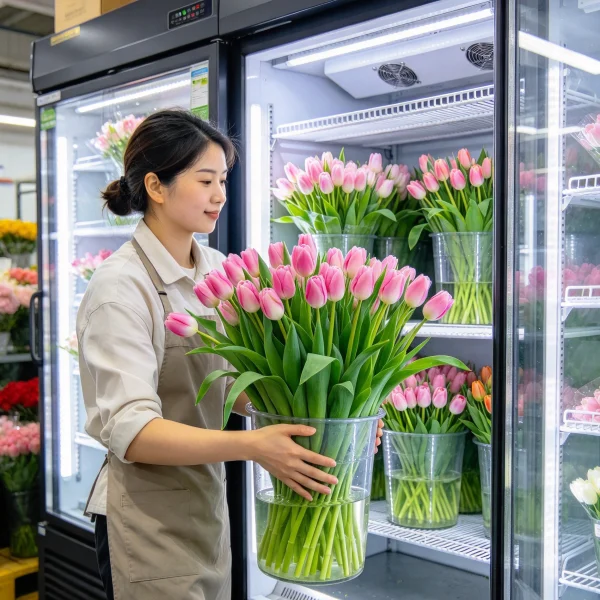
Fresh bouquets hold 5 to 10 days in a properly chilled case. Let the cabinet drift to 12°C and that falls to 3 or 4 days, which is the difference between a route that works and one that quietly bleeds money.
Every restock visit costs labour and fuel, so the goal is fewer, larger visits. That means a flower supplier who delivers on a fixed schedule, buckets that go straight from the van into the case, and a rotation rule written down somewhere everyone can see. First in, first out, including the bouquets you personally like the look of.
Ethylene is the other thing that catches people out. Ripening fruit gives it off and it ages cut flowers fast. Don’t put a unit beside a produce section or a fruit stand if you can avoid it. When the location forces your hand, ask the supplier for a cabinet with an ethylene filter fitted.
You also need a plan for what happens to unsold stock. Marking a bouquet down to $5 on day four recovers your cost. Throwing it in the bin on day eight recovers nothing and teaches you the wrong lesson.
Vetting a supplier before you wire money
This is where most first-time buyers lose money. Every brochure photo looks the same, so the differences show up in the paperwork and the spare parts bin.
Work through this before paying a deposit:
- Refrigeration spec, including compressor brand and rated pull-down time.
- A 24-hour temperature log from a live unit in a real location.
- MDB support, which card readers are certified, and who configures the terminal.
- Telemetry included or extra, plus any monthly SIM or platform fee.
- Spare parts held locally, with a named technician who can reach your site.
- Compressor warranty length in years, confirmed in writing.
- Two operator references in your own country that you can actually phone.
- Lead time and installation scope, including who handles the power connection.
On VendingCore you can compare verified suppliers side by side, read buyer reviews, check price ranges, and send an inquiry directly rather than chasing five factory inboxes for a straight answer. The same vetting logic carries over between categories, whether you’re buying a chilled floral case or checking where to buy phone case printing vending machines in the USA. Fresh-made drink machines follow an almost identical process, as this guide to the fully automatic bubble tea vending machine makes clear.
What payback looks like in real numbers
The spread is wide, which is why nobody can honestly promise you a payback figure before they’ve seen the site. These three scenarios assume an $8,000 machine, a $350 to $500 monthly site fee, $60 to $100 in power, and cost of goods between 35% and 38%.
| Site quality | Sales per day | Average ticket | Net per month | Payback |
|---|---|---|---|---|
| Cautious site | 5 | $12 | about $820 | 9 to 10 months |
| Solid site | 10 | $14 | about $2,300 | 3 to 4 months |
| Strong site | 14 | $15 | about $3,400 | 2 to 3 months |
Notice how much the site matters compared with the machine. Doubling footfall does more for your payback than saving $1,500 on the hardware ever will, and it costs nothing extra to walk away from a weak location before you sign.
Mistakes that quietly kill a route
- Buying on price and skipping telemetry, then finding out about a warm cabinet from customer complaints.
- Overloading the case on day one. Sparse, fresh stock sells better than a crowded case of fading flowers.
- Ignoring the power supply. A shared circuit that trips every time the compressor kicks in will cost you a weekend of sales.
- Choosing a supplier with no local spare parts, so a $90 fan motor keeps the machine dark for three weeks.
- Treating it as passive income. Somebody has to restock, rotate and reconcile cash, and that somebody is usually you.
- Skipping the written rotation rule, then wondering why the same two bouquets are always the last ones left.
None of these are exotic problems. They’re the ordinary ones that turn a good location into a mediocre performer, and every one of them is cheaper to prevent than to fix.
Getting to a real quote
Start with the site, not the machine. Measure the foot traffic, confirm the power, agree a short trial on the fee, then go shopping for hardware with a specific capacity and temperature spec in hand. Suppliers respond very differently when you arrive knowing what you want.
When you’re ready to compare, browse the supplier directory on VendingCore to see verified manufacturers, read what other buyers reported, check current price ranges, and send an inquiry directly from the listing. It takes a few minutes and it beats emailing a dozen addresses off a search page.
FAQ
How much does a flower vending machine cost?
Most buyers pay between $3,800 for a small single-stem unit and $18,000 for a large locker-style refrigerated case. Custom branded units for florists and event venues run $15,000 to $32,000. Add 8% to 15% for delivery, installation and card reader activation, plus your first flower order and a spare-parts kit.
Do these machines actually keep flowers fresh?
Yes, if the cabinet holds 2 to 8°C with humidity around 80 to 90%. At that range, cut flowers typically last 5 to 10 days, similar to a florist’s cooler. A unit running at 12°C or in dry air cuts that to 3 or 4 days, so insist on a live temperature log before you buy.
How many bouquets does one machine hold?
Small cup-style units hold 18 to 30 single stems. Carousel machines hold 18 to 28 bouquets, which suits most hospital and transit sites. Locker-style refrigerated cases hold 30 to 48 items. Filling every slot on day one is usually a mistake, since slow sellers age while you wait for them to move.
What is the best location for one?
Hospital entrances perform best because visitors arrive without a gift and the gift shop is closed. Metro platforms, cemeteries, hotel lobbies, wedding venues and university campuses also work well. The deciding factor is evening and weekend footfall, not daytime traffic, so visit the site after 8pm before committing.
How long until it pays for itself?
Realistic payback sits between 2 and 10 months depending on the site. A weak location turning 5 sales a day at $12 pays back in 9 to 10 months. A solid site doing 10 sales a day at $14 pays back in 3 to 4 months. Footfall drives the number far more than the purchase price does.
What payment methods do customers use?
Nearly all current units run on an MDB controller, the same protocol used in drink and snack machines. That means contactless cards, mobile wallets and QR code payments work out of the box with a certified reader. Cash acceptors are still available but rarely worth it now, since card-only sites see fewer jams and simpler cash handling.
Do I need a permit or a business licence?
Requirements vary by country, state and site. You’ll usually need a general business licence and a signed site agreement with the property owner. Some venues also ask for liability insurance. Check whether your site classifies the machine as retail or as an amenity, because that changes the paperwork and sometimes the electricity billing.
Can I brand a machine for my flower shop?
Yes. Most manufacturers offer custom wraps, coloured powder coating and screen-printed logos, and premium units are built for it. Branding typically adds 10% to 20% to the base price and one to three weeks to lead time. If you run a shop and want an unattended sales channel for after-hours trade, it’s usually the version worth choosing.
A chilled floral unit only works when the cold chain is boring. The operators who do well restock on a fixed schedule, keep the case near 4°C, and rotate stock on every visit without exception. The ones who struggle usually bought on price, skipped the telemetry, and only discovered the cabinet was running warm when customers started sending photos of wilted roses. Spend your first week measuring evening footfall at three candidate sites before you spend anything on hardware, and insist on a live temperature log from the supplier. That single document tells you more about build quality than any brochure.