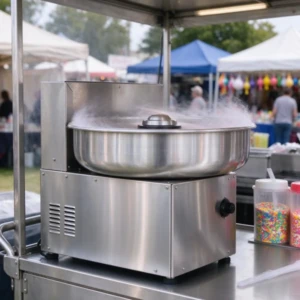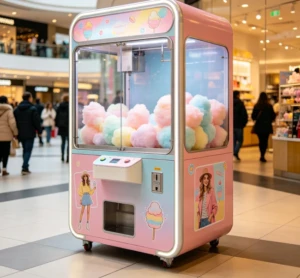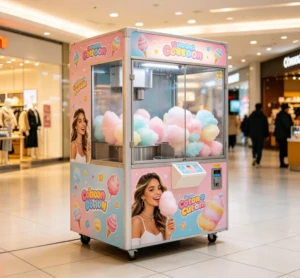
Cotton candy machine suppliers fall into three groups: Chinese OEM factories, regional distributors holding local stock, and refurbished-machine resellers, with single-unit prices running from about $2,800 to $9,500 in 2026. The machine melts sugar in a heated head, spins it into fine threads with a high-speed motor, and collects the candy in a cup or cone, so what you are really buying is a spinner head, a motor that survives daily use, and payment hardware that fits your location. These units turn up in shopping malls, cinemas, family entertainment centers, and trampoline parks, usually somewhere near a food court entrance, and first-time buyers care most about spare parts availability and how fast the supplier answers the phone.
What a cotton candy vending machine actually does
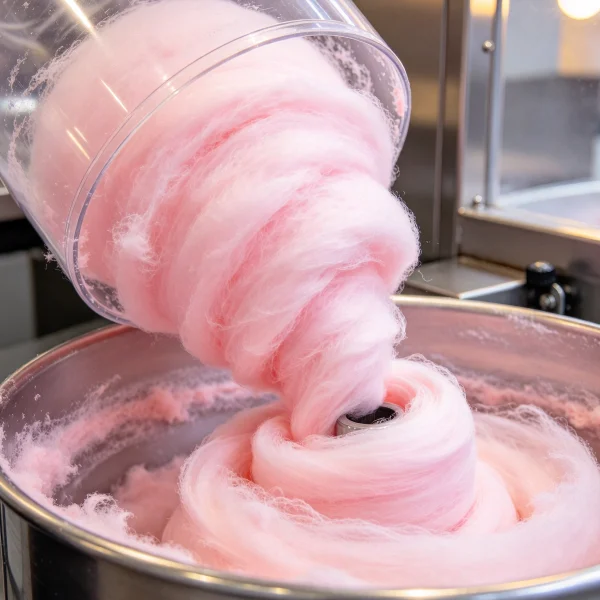
A cotton candy vending machine is a self-service unit that melts granulated sugar in a heated spinner head, forces it through fine holes at roughly 3,000 to 4,000 RPM, and collects the threads into a cup or cone. A vend takes 45 to 90 seconds depending on the size setting. There’s no mixing, no refrigeration, and far less that can go wrong than in a coffee or bubble tea unit. That simplicity is a big part of why operators like the category.
Most commercial models hold 2 to 4 kg of sugar, which works out to somewhere between 120 and 200 vends before anyone needs to refill. Power draw stays modest at 300 to 800W on single-phase 110V or 220V, and the footprint usually comes in under one square meter. You can tuck one into a corridor corner where nothing else fits.
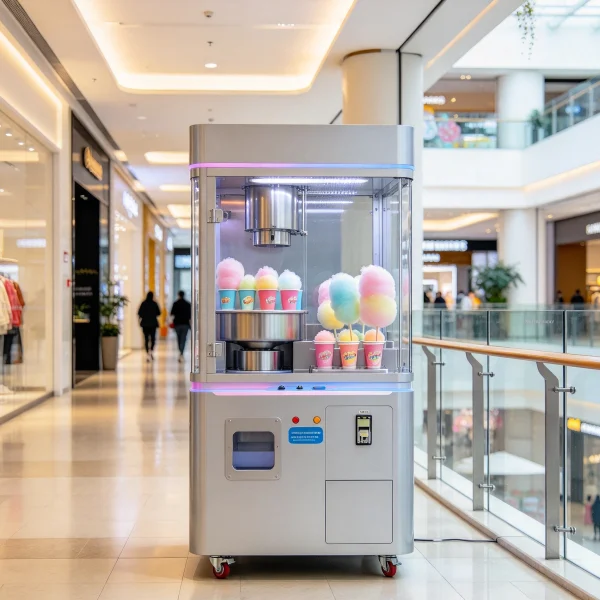
If you want to see how the common configurations stack up before you talk to anyone, our cotton candy vending machine guide covers the models that ship most often.
Payment is where cheap suppliers give themselves away. A machine with only a coin acceptor will lose sales in a market that pays by card or phone. Ask whether the controller supports MDB protocol before you order. Adding MDB later is possible on some boards and impossible on others, and the retrofit often costs as much as the card reader itself.
Cup or cone?
Cups are the safer default. They stack flat, they don’t crack in transit, and the dispensing mechanism has fewer moving parts. Cones photograph better and sell well in tourist areas, though the paper cone feed jams more often and needs cleaning most weeks.
Then there’s the sugar
Fine, dry floss sugar flows properly through the head. Coarse supermarket sugar clumps in the hopper and burns onto the heating element. Plenty of suppliers will tell you any sugar works. Most of them haven’t run a machine through a humid August.
Three supplier types, and who each one suits
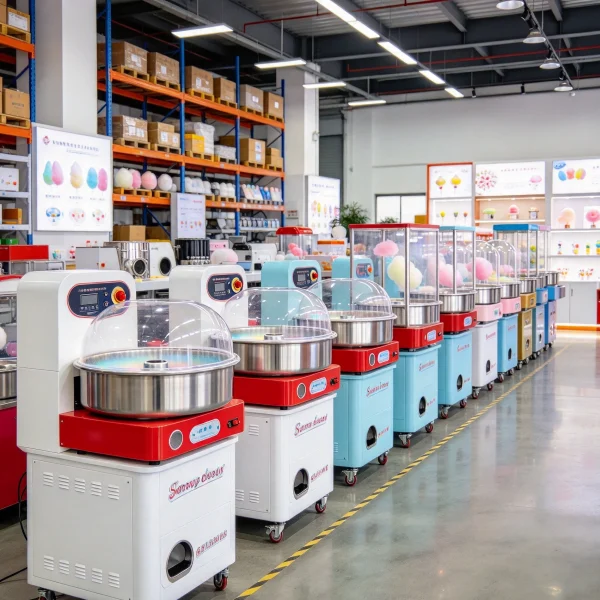
Where you buy changes what you pay, and it changes what happens when a machine dies at 9pm on a Saturday. Here’s how the routes compare.
| Supplier type | Typical unit price | MOQ | Lead time | Warranty | Best for |
|---|---|---|---|---|---|
| OEM factory, direct | $2,800 to $5,200 | 1 to 5 units | 25 to 45 days | 12 months, parts only | Buyers ordering two or more units |
| Regional distributor | $5,500 to $9,500 | 1 unit | 3 to 10 days | 12 to 24 months, on-site | First-timers who want local support |
| Refurbished reseller | $1,800 to $3,200 | 1 unit | 1 to 3 weeks | 3 to 6 months | Testing a new location cheaply |
| Trading company or marketplace lister | $2,400 to $4,800 | 1 to 10 units | 30 to 50 days | Often unclear | Shoppers willing to verify the real factory |
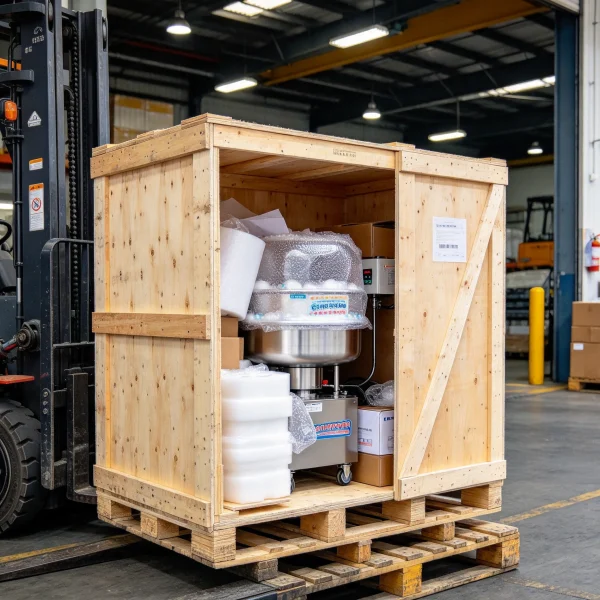
Going direct to a factory gives you the lowest unit price. In exchange, you handle freight, customs paperwork, and the time zone gap during warranty claims. Order two or more units and the savings usually cover those costs several times over.
A regional distributor charges 30 to 60 percent more per machine. What you’re paying for is a phone number that gets answered and a technician who can reach the site within a day or two. For a single unit in a prime spot, that trade is often worth making.
Refurbished machines make sense when you want to test a location before committing real money. Ask how many hours are on the spinner head, and check whether replacement heads are still in production. Vague answers on either point are your cue to walk.
How to vet a supplier before you send a deposit
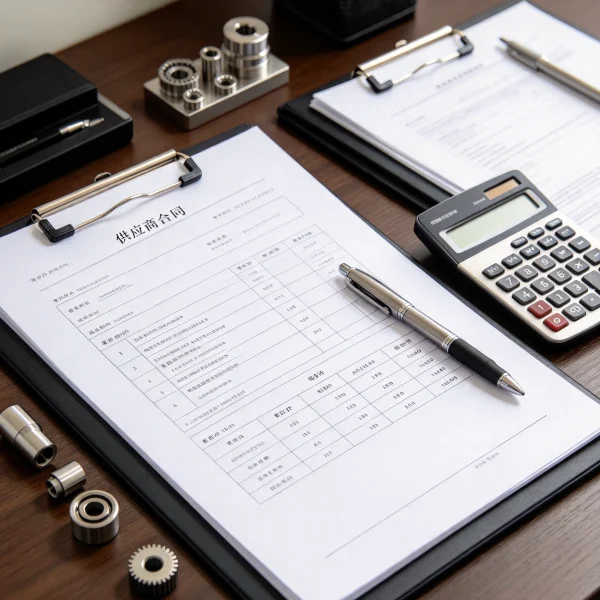
The main things to check when buying a cotton candy machine are certification, spare parts availability, and warranty terms. Anyone can put up a website with a factory photo. Paperwork is what separates a real manufacturer from a trading company reselling someone else’s catalog.
- Business license that matches the company name on your invoice
- CE, UL, or ETL certification for the electrical build, not just a photo of a sticker
- ISO 9001 if they describe themselves as a factory
- A written spare parts price list with lead times attached
- Two or three trade references in your region you can actually call
- A live video walkthrough of the production floor
- Warranty terms spelled out: covered parts, who pays shipping, response window
- Payment structure that protects you, such as 30% deposit and the balance against a Bill of Lading copy
Pay attention to hesitation. A supplier who stalls on the parts list or refuses a live walkthrough is telling you something useful. Take the hint and keep looking. If you’d rather start from a filtered list, VendingCore shows verification status and buyer reviews alongside each supplier listing.
What the machine really costs once it lands
That $3,600 figure on the PDF isn’t what the unit costs you. Here’s a worked example for one machine shipped to a Gulf port.
| Cost item | Amount |
|---|---|
| Machine price (FOB) | $3,600 |
| Sea freight to port | $550 |
| Customs duty at 5% | $180 |
| Clearance and documentation | $220 |
| Inland delivery | $150 |
| Card or QR payment terminal | $280 |
| Initial sugar and cup stock | $200 |
| Total landed cost | $5,180 |
Divide your monthly revenue by the landed number, not the invoice number. First-time buyers routinely budget for the machine and then find themselves short by a third before the unit is even plugged in. For a fuller regional breakdown, the guide to how much a vending machine costs in the UAE walks through duty, clearance, and local delivery in more detail.
Which specs are worth the extra money
Three grades dominate the market, and the gap between them shows up in three places: the head, the payment board, and the steel.
| Specification | Entry level | Mid-range | Premium |
|---|---|---|---|
| Sugar capacity | 1.5 kg | 3 kg | 4 kg |
| Vends per fill | about 90 | about 180 | about 240 |
| Spinner head | Aluminum, single | Stainless steel, single | Stainless steel, dual |
| Payment options | Coin only | Coin and bill | Coin, bill, card or QR via MDB |
| Power draw | 300W | 500W | 800W |
| Dimensions (W x D x H) | 60 x 55 x 170 cm | 75 x 70 x 180 cm | 90 x 80 x 190 cm |
| Typical price | $2,800 to $3,600 | $4,200 to $6,000 | $6,500 to $9,500 |
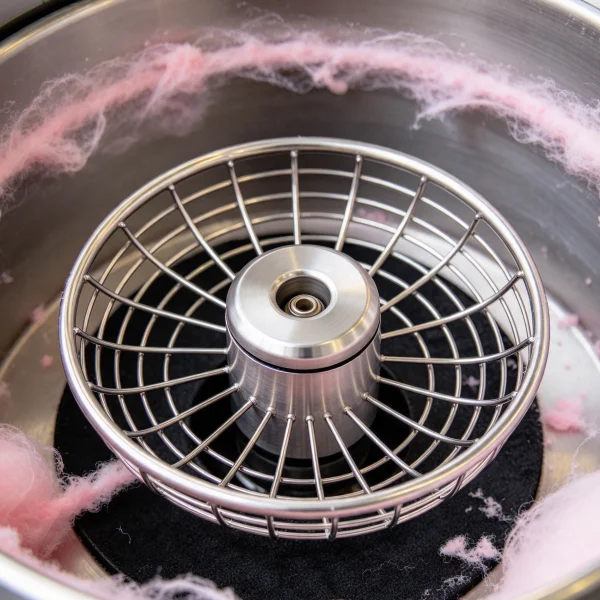
Two items on that table earn their premium. A stainless steel spinner head outlasts aluminum by a wide margin in daily use, and MDB support decides whether you can take card payments without swapping the control board later.
What you can skip
Built-in LED screens advertising your brand sound attractive until you price them. A printed vinyl wrap does the same job for a fraction of the cost. Remote telemetry is genuinely useful when you run five machines in different buildings, and close to pointless when you own one you walk past every morning on the way to work.
Payback math for a real location
Numbers make this easier. Cotton candy sells for roughly $2.50 to $4.00 in Gulf and European markets. Materials run about 40 to 60 cents per vend once you count sugar, cup, stick, and bag.
Take a mid-size mall food court. Weekends might do 80 to 150 vends a day, weekdays 40 to 70. Average 60 a day at $3.00 and you’re at $180 daily, or about $5,400 a month. Rent, power, and restocking might eat $1,200 of that. On a $5,180 landed machine, payback lands somewhere around 4 to 8 months. A cinema lobby with strong evening traffic can pay back in 3 to 5 months instead, which is why operators fight over those spots.
A weak location doing 15 vends a day tells a different story. It won’t pay back inside 10 months, and no supplier on earth fixes that. If you’re still choosing between sites, a flower vending machine or a coffee unit may suit the exact spot better than candy does. Operators chasing higher ticket sizes often price out coffee vending machines for sale for the same reason.

Comparing suppliers without three weeks of email
Quotes arrive in different currencies, covering different items, and half of them list a machine model that doesn’t quite match the catalog photo. Comparing them line by line gets old fast. On VendingCore you can compare verified suppliers, read buyer reviews, check price ranges, and send an inquiry directly, which shortens the shortlist stage considerably.
The same checklist works whatever machine you’re sourcing. If a photo-print kiosk interests you more, the sourcing notes on where to buy phone case vending machines follow the same verification steps.
What to take away
The lowest unit price rarely wins once freight, duty, spare parts, and downtime get added in. Fix the location first, choose the machine spec second, and treat the supplier as a service relationship rather than a one-time transaction. Ask for the live walkthrough, get the parts list in writing, and watch how quickly answers come back before you’ve paid anything.
Then let the market come to you. Browse the verified supplier listings on VendingCore, filter by your region and budget, and send your first inquiry. Most suppliers reply within a business day, and you’ll usually have three or four comparable quotes in hand faster than you’d expect.
FAQ
How much do cotton candy machine suppliers charge per unit?
A single commercial unit runs about $2,800 to $5,200 direct from an overseas factory, and $5,500 to $9,500 from a regional distributor who holds stock locally. Refurbished machines sit lower, around $1,800 to $3,200. Those figures are usually FOB or ex-warehouse, so freight, duty, and clearance come on top. Budget another 15 to 25 percent to reach your true landed cost.
What does it cost to run one per month?
Sugar, cups, sticks, and bags run about 40 to 60 cents per vend. Power is minor at 300 to 800W for a minute at a time. Maintenance is mostly cleaning plus an occasional spinner head or belt, and the part typically costs $60 to $150. The dominant running cost is location rent, and that varies enormously. A mall slot can cost ten times a cinema corridor.
Where can I compare suppliers before requesting quotes?
On VendingCore you can compare verified suppliers side by side, read reviews from other buyers, check price ranges, and send an inquiry directly. The directory covers several machine categories, so you can weigh a candy unit against a flower or coffee machine for the same spot. Start with a region and budget filter, then shortlist three suppliers before you request pricing.
What is the minimum order quantity?
Most Chinese factories will sell a single unit, although pricing improves sharply at three to five. Some marketplace listers advertise an MOQ of one and then add a sample surcharge. Regional distributors usually have no MOQ at all since the machine already sits in their warehouse. If you plan to add locations later, negotiating a five-unit price now often beats the discount you’d get on a repeat order.
How long does shipping take?
Sea freight from China to a Gulf port runs 25 to 45 days door to door once production finishes. Production itself takes 15 to 30 days for a standard model and longer for custom wraps. Air freight cuts transit to roughly a week but can double your shipping cost, which rarely makes sense for a unit this size. Regional distributors ship in 3 to 10 days.
Can I add a card reader after buying?
Only if the control board supports MDB protocol. Many entry-level machines ship with a coin acceptor and no MDB port, and retrofitting one can cost as much as the reader itself. Ask the supplier for a photo of the control board plus written confirmation of MDB support before you order. Card and QR payments usually account for most transactions in malls and cinemas.
What is the biggest mistake first-time buyers make?
Choosing a machine before choosing a location. Buyers spend weeks comparing spinner heads and motors, then place the unit somewhere with 20 people an hour walking past. A mediocre machine in a busy food court will out-earn a premium unit in a quiet corridor every single month. Test footfall for a week, ask the site manager for real traffic numbers, and only then start negotiating with suppliers.
There’s a version of this business where you buy the cheapest machine you can find and hope. It works maybe one time in five. The operators who stay in it treat the supplier like a service contract instead of a shopping cart. They want the spare parts list before the price list, they want to know who answers the phone on a Friday night, and they want a control board they can actually upgrade. Candy is a low-ticket product, so uptime matters more than margin per vend. Every day a machine sits dark, you’re paying rent on a box.