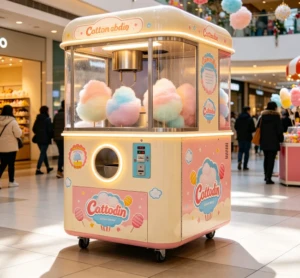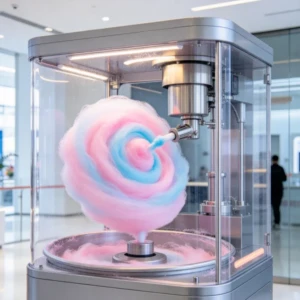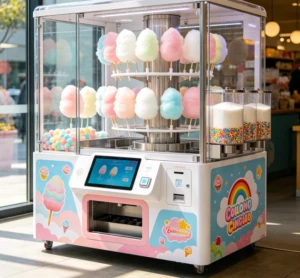
A cotton candy vending machine for mall placement usually costs between $1,800 and $6,500, occupies about one square meter, and spins a single cup or cone in 30 to 60 seconds. You pour sugar into the hopper, the machine heats it to roughly 180 to 200°C and spins it into a fluffy nest that drops into a paper cup or wraps around a stick. Malls suit them because the unit runs unattended, fills the corridor with a fairground smell, and sells to kids while their parents are still shopping. Cups usually retail at $4 to $6, and the sugar bowl needs a refill every 40 to 60 servings.
How a cotton candy machine in a mall actually works
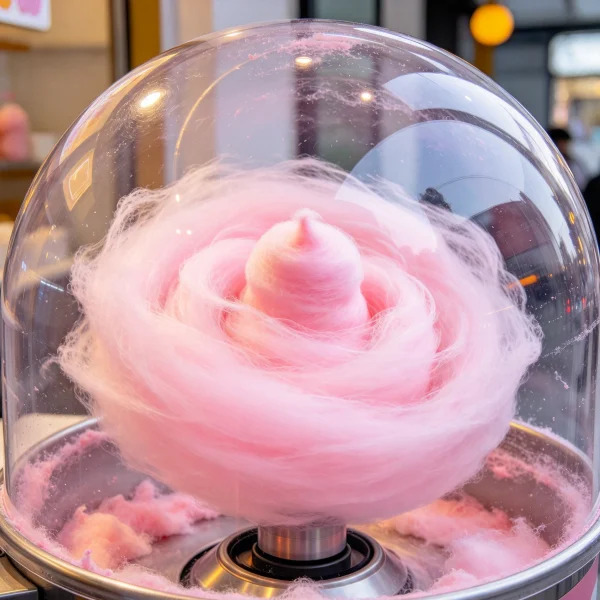
The mechanism hasn’t changed much in decades. A heating element melts granulated sugar inside a spinning head, and centrifugal force pushes the melted sugar through tiny holes, where it cools into fine strands. Those strands collect in a bowl, and the machine drops them into a cup or wraps them onto a stick.
Everything around the mechanism has changed. Modern units handle the cup drop, the wrapping, and the payment with nobody standing there. Cycle time runs 30 to 60 seconds, and most hoppers hold 1 to 3 kg of sugar, which works out to 40 to 60 servings. Add a card reader and 4G telemetry and you can watch sales from your phone instead of driving to the mall to count coins.
Watch one run in person before you buy. Cycle time on a spec sheet and cycle time in a crowded corridor are different numbers, and a machine that jams a cup on every twentieth sale will earn you a monthly service call.
Why malls beat almost every other location
Foot traffic gets the attention, but dwell time does the selling. A convenience store gets roughly 90 seconds of someone’s attention. A mall keeps people inside for an hour or two, and that’s when impulse spending happens.
Kids are the trigger. Stand near a machine for an hour and the pattern repeats: a child spots the spinning sugar, the parent says no, the child negotiates, and two minutes later money changes hands. School holidays, weekends, and the quarter hour after a cinema screening does most of the work.
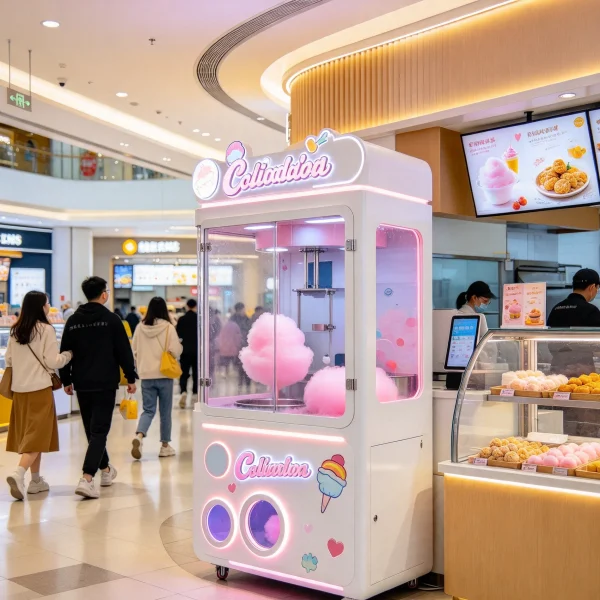
Mall management prices the spot to match. Expect either 15% to 25% of gross revenue or a fixed monthly fee, and read the contract to see which one applies to a slow month.
What one machine actually earns
Revenue comes down to three numbers: cups per day, price per cup, and the mall’s cut. Here’s the per-cup math most operators start from.
| Line item | Typical range per cup |
|---|---|
| Retail price | $4.00 to $6.00 |
| Sugar, 15 to 25 g | $0.08 to $0.15 |
| Cup, stick, and bag | $0.10 to $0.20 |
| Mall commission, 15% to 25% | $0.60 to $1.50 |
| Card processing, 2% to 4% | $0.08 to $0.24 |
| Net left to the operator | about $2.60 to $4.60 |
Volume is where the guesswork lives. A strong spot near a cinema or food court can move 40 to 80 cups on a Saturday and 15 to 30 on a Tuesday, so plan on an average between 20 and 35 cups a day for a mid-tier mall. Assume month one is weaker while shoppers notice the machine exists.

If you want the same margin math applied to other machine categories, our 2026 breakdown of vending machine profitability walks through costs and location quality across machine types.
Other mall formats run on the same impulse logic. Photo puzzle kiosks sell personalization instead of snacks and often sit in the same corridor. If you’re comparing formats, the nail vending machine business guide breaks down the cost structure for a personalized kiosk, and this read on AI nail printers versus salon visits explains why customers pay a machine premium in the first place.
Specs that decide whether the machine survives mall life
| Spec | What to look for |
|---|---|
| Footprint | 0.8 to 1.2 m² (0.9 x 1.1 m is a common footprint) |
| Height and weight | 1.7 to 2.0 m tall, 150 to 250 kg |
| Power | 220 V single phase, 1.5 to 2.5 kW |
| Sugar capacity | 1 to 3 kg hopper, good for 40 to 60 servings |
| Cycle time | 30 to 60 seconds per cup |
| Throughput | 40 to 60 cups per hour in continuous use |
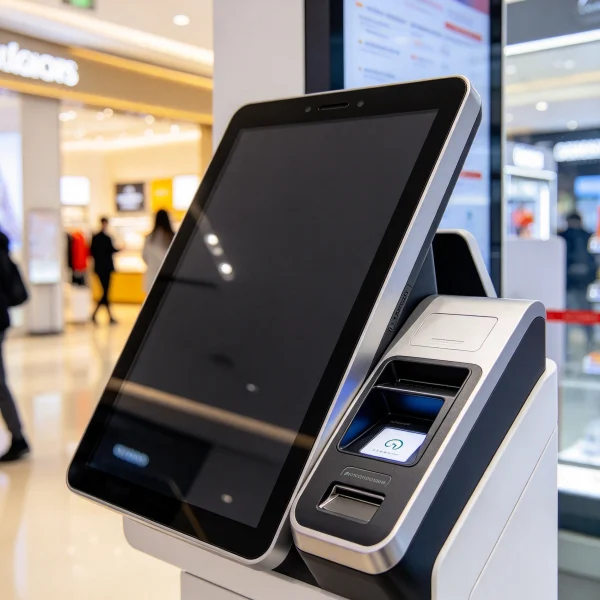
| Payment | MDB controller with coin, bill, and card |
| Telemetry | 4G or WiFi sales reporting |
| Flavors | 1 to 4 hoppers, such as plain, strawberry, blue raspberry, mango |
Two specs matter more than the rest. Footprint and weight come first, because malls restrict kiosk placement and may ask for a floor-load check on anything above 200 kg. Payment protocol comes second. Machines that speak MDB let you swap in a different card reader later without replacing the controller, which matters because card readers age faster than the machine itself.
What these machines cost, by tier
| Tier | Price | What you get |
|---|---|---|
| Entry | $1,800 to $2,800 | One flavor, coin and bill, manual cup placement |
| Mid-range | $3,000 to $4,500 | 2 to 4 flavors, card reader, automatic cup drop |
| Premium | $5,000 to $7,500 | Touchscreen, telemetry, robotic arm or double hopper, custom branding |
The gap between tiers is mostly automation and flavor count. A single-flavor machine with coin and bill payment does the same job as a four-flavor unit with a touchscreen. It just needs a person nearby more often and makes less money per transaction.
How to pick a supplier without getting burned
First-time buyers lose money here more often than on the machine itself. Ask every supplier the same questions and compare the answers side by side.
- A video of the exact model running, not a stock photo
- Confirmed voltage and whether the unit needs a dedicated circuit
- Which payment protocol the controller speaks (MDB is the one to want)
- Spare part availability for the heater head, motor, and cup dispenser
- Warranty length and what it excludes
- Two references from operators running that model in a mall
- Who arranges shipping, customs, and duty
On VendingCore you can compare verified suppliers side by side, read real buyer reviews, check price ranges, and send an inquiry directly instead of emailing five factories and waiting a week for three replies.
If you’re still deciding whether the category deserves your money at all, our analysis of whether vending machines are still a good investment covers payback and risk with 2026 numbers.
Lease, permits, and insurance before you plug in
Six things should be in place before the machine ships:
- A business license for the city where the mall sits
- A health department permit, because sugar counts as food
- General liability insurance of $1M to $2M, with the mall named as additional insured
- A signed lease stating revenue share or fixed rent, lease term, and deposit
- Written approval of your exact machine model and dimensions
- Access to a dedicated circuit near the placement spot
Don’t order the machine before the lease is signed. Operators who buy first and negotiate later end up with a unit sitting in a garage while they hunt for a spot, and mall leasing teams can take four to eight weeks to approve a new kiosk.
Daily routine and what actually breaks
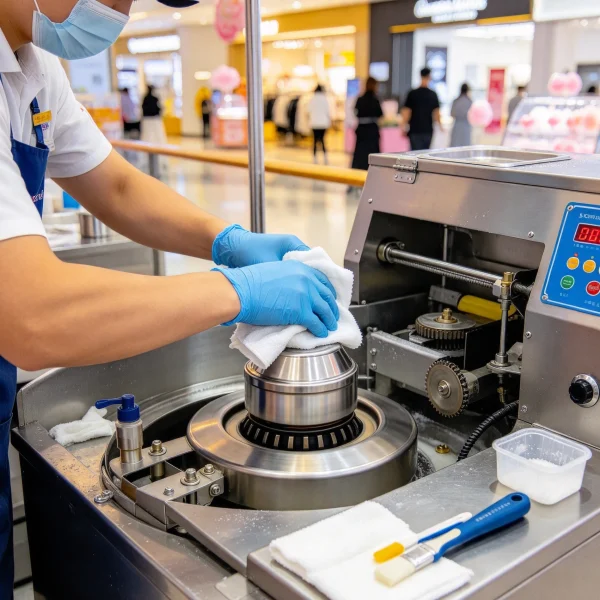
Ten minutes a day keeps most machines running. Wipe the bowl and the outside of the glass, empty the waste bin, top up sugar and cups, and run a test card transaction once a week.
The parts that fail are predictable. The heater head and the cup dispenser go first, usually after 12 to 18 months of heavy weekend use, so keep one spare of each. Sugar dust causes more long-term trouble than the sugar itself: it builds up on the spinner and unbalances it, which shows up as wobble and a messier wrap.
Payback: what a realistic timeline looks like
Add it up honestly. A mid-range machine at $4,200, plus shipping, a card reader, permits, insurance, signage, and the first month of stock, lands somewhere near $5,500 to $6,500 all in.
At 20 cups a day and roughly $3 net per cup after commission and processing, you’re looking at about $1,800 a month before insurance, power, and consumables, which run $150 to $250. Call it $1,600 net. That puts break-even near month four. A strong spot pulls that down to three months, while a weak location near a dead anchor store can stretch to nine or ten.
The short version before you sign anything
Here’s the whole decision in five lines:
- Budget $5,500 to $6,500 all in for a mid-range machine, not just the sticker price.
- Placement beats brand. Thirty meters from a cinema exit is worth more than a nicer machine.
- Insist on MDB, a card reader, and one spare heater head before the unit ships.
- Sign the lease first and order the machine second.
- Plan on break-even in three to seven months in a decent spot.
When you’re ready for quotes, browse the VendingCore supplier directory, compare verified suppliers on price and warranty, read what other buyers said, and send your inquiry directly. You’ll get real numbers in a few days instead of guessing from a spec sheet.
FAQ
How much does a cotton candy vending machine for mall locations cost?
Machines run $1,800 to $6,500 depending on flavor count, cup automation, and payment hardware. Your true all-in number for a mid-range unit is closer to $5,500 to $6,500 once you add shipping, a card reader, permits, insurance, signage, and the first month of sugar and cups. Always quote the all-in figure when you’re comparing suppliers, because delivery and duty can add hundreds on a cheap machine.
How many cups can I realistically sell per day in a mall?
Plan on 20 to 35 cups a day as an average for a mid-tier mall. Strong spots near a cinema or food court can hit 40 to 80 cups on a Saturday and drop to 15 to 30 on a Tuesday. Your first month will be lower while shoppers discover the machine. Count foot traffic at your exact spot on a Saturday before you commit to a commission rate.
Do I need a permit or mall approval to run one?
Yes to both. You’ll need a city business license, a health department food permit because sugar is a food product, and general liability insurance of $1M to $2M with the mall named as additional insured. The mall also has to approve your exact machine model, height, weight, and power draw. Approval usually takes four to eight weeks, so start the paperwork before you place an order.
How fast does the machine make a cotton candy?
A typical unit spins one cup or cone in 30 to 60 seconds, and it can keep that pace for 40 to 60 cups an hour in continuous use. Speed matters less than reliability. Ask a supplier for uncut video of the machine making ten cups in a row, because a unit that jams the cup dispenser every twentieth sale creates a service call and a queue.
What payment options should the machine support?
Card payments are close to mandatory in a mall. Look for an MDB controller so you can plug in or replace a card reader without swapping the whole board, and keep coin and bill acceptance alongside it for kids spending pocket money. Card processing typically costs 2% to 4% of each sale, which is already baked into the per-cup margin math.
How long until the machine pays for itself?
Three to seven months is the realistic window for a decent mall location. A mid-range machine plus installation, permits, and insurance lands near $5,500 to $6,500 all in, and a machine averaging 20 cups a day at about $3 net per cup returns roughly $1,600 a month before small fixed costs. Weak spots near a failing anchor store can take nine or ten months.
How do I find a supplier I can actually trust?
Ask every supplier for running video of the exact model, the payment protocol, spare part availability, warranty terms, and two operator references in a mall setting. Compare at least four quotes. On VendingCore you can compare verified suppliers side by side, read buyer reviews, and send an inquiry directly, which saves the weeks of back-and-forth that comes from emailing factories one at a time.
What maintenance does a cotton candy machine need?
Daily: wipe the bowl and glass, empty the waste bin, and top up sugar and cups. Weekly: run a test card transaction and clean sugar dust off the spinner, since buildup unbalances the head and produces a messy wrap. The heater head and cup dispenser tend to fail after 12 to 18 months of weekend-heavy use, so keep one spare of each on hand.
The machine is the easy part, and it’s the part everyone obsesses over. What decides whether a mall unit makes money is the lease and the location inside the building. I run one machine twenty meters from a cinema exit that does three times the volume of an identical unit at the far end of the same corridor. Before you compare machines, walk the mall on a Saturday, stand where you’d put it, and count how many families pass in twenty minutes. Then negotiate the commission with that number in front of you.