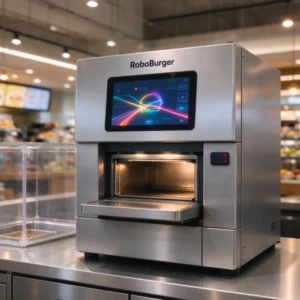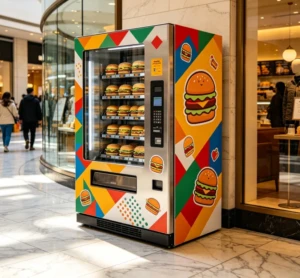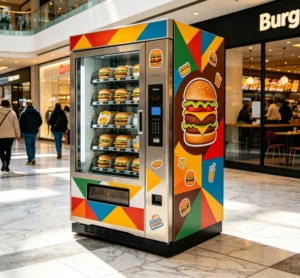
A burger vending machine from China typically costs $6,500 to $22,000 FOB, holds 20 to 120 burgers, and serves a hot assembled burger in 55 to 120 seconds. You’ll find these units in university canteens, factory break rooms, highway service areas, and 24-hour gas stations where the kitchen is shut. A customer taps the screen, pays by card or QR code, and waits roughly ninety seconds. Inside, the machine keeps buns and patties chilled, then heats and assembles the bun, patty, sauce, and toppings to order.
What the machine actually is
A burger vending machine is a fresh burger maker that heats and assembles the patty, bun, and toppings to serve a ready burger. Unlike a snack machine, it holds chilled ingredients and cooks each order on the spot instead of dropping pre-wrapped food into a tray. That difference drives power draw, cleaning time, food safety paperwork, and how often you restock.
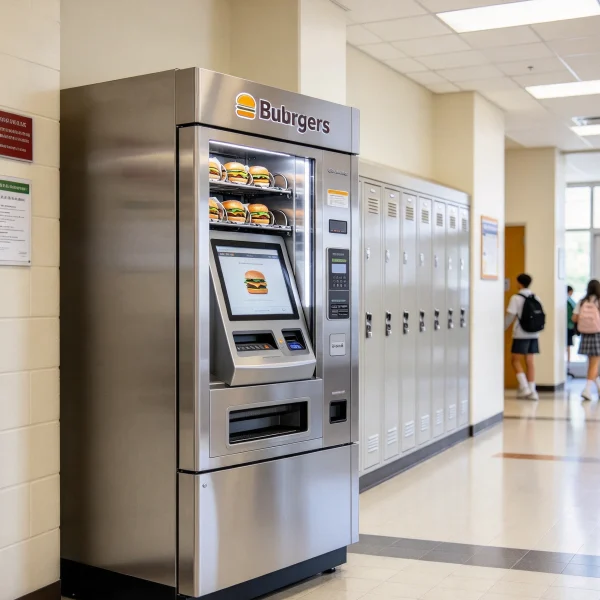
Chinese factories build two broad families. The first is a mid-size cabinet with one convection oven and room for 20 to 40 burgers. The second is a freestanding double-oven unit, often 1.9 to 2.2 meters tall, with two heating chambers so one patty cooks while the next burger is assembled. The taller unit costs more, and the throughput gap is real: a single-oven machine bottlenecks around 25 burgers an hour, while a dual-oven model can push 60.
How the loop works, from payment to hot burger
Every unit runs the same six-step sequence. Knowing it makes a factory video call far more useful, because you’ll spot which questions expose weak design.
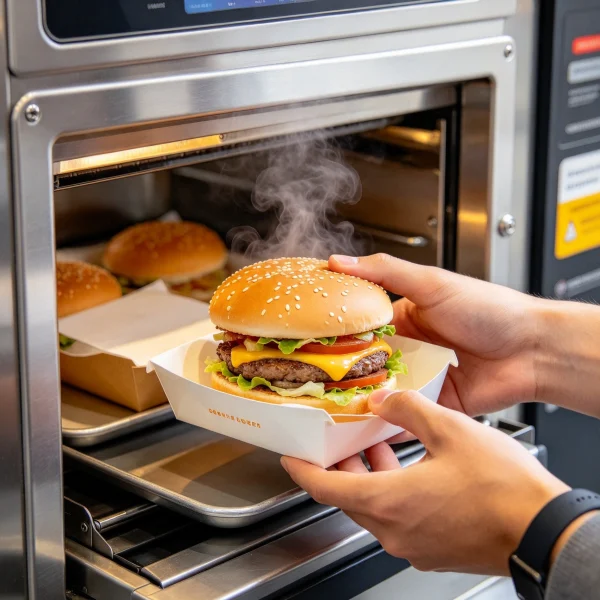
- The customer picks a burger on the touchscreen and pays by card, QR code, or cash.
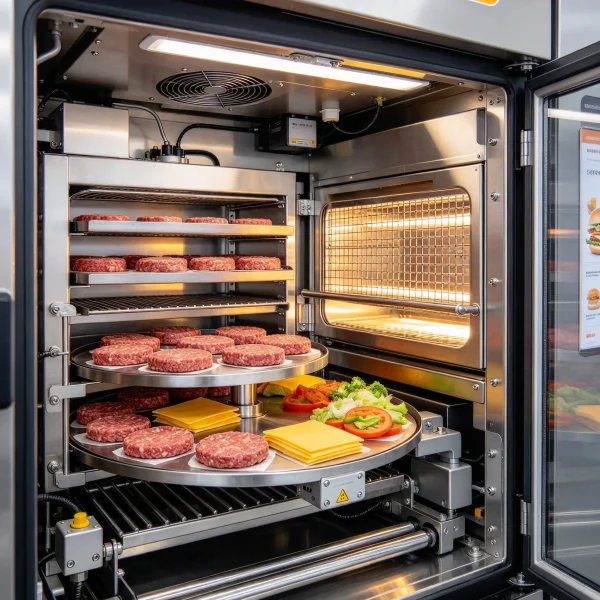
- A refrigerated carousel indexes the matching bun and patty into position.
- A gripper loads the patty onto a hot plate or into a convection chamber set between 180°C and 230°C.
- The patty cooks for 45 to 90 seconds, depending on thickness and whether it starts raw or pre-cooked.
- Sauce, cheese, lettuce, onion, or tomato come from separate chilled canisters and pumps.
- The finished burger drops to a heated door, usually held at 60°C to 70°C.
Ask which parts touch food and how you pull them out. Anything that takes more than ten minutes to remove and wash by hand gets skipped on a busy Friday night. I’ve watched operators give up on a machine for that one reason.
What it costs, and what actually lands on your invoice
FOB prices cluster into three bands. The spread comes from oven count, refrigeration type, capacity, and whether the card reader is included. Chinese factories quote FOB from Shenzhen, Ningbo, or Qingdao, and you pay freight and duty on top of that number.
| Class | Typical FOB price | Burger capacity | Serve cycle | Where it fits |
|---|---|---|---|---|
| Countertop, single oven | $6,500 – $9,500 | 20 – 30 | 90 – 120 s | Office pantry, small cafe |
| Freestanding, single oven | $10,000 – $15,000 | 40 – 60 | 75 – 100 s | Campus canteen, gas station |
| Dual oven, high capacity | $16,000 – $22,000 | 80 – 120 | 55 – 80 s | Transit hub, stadium, mall |
FOB is not your final number. Here’s a realistic landed cost for a mid-tier machine quoted at $12,000 FOB and shipped in a shared 20-foot container.
| Cost line | Typical amount | Notes |
|---|---|---|
| Machine, FOB China | $12,000 | Ask for a 30-day price validity |
| Ocean freight, LCL or shared FCL | $700 – $1,400 | Wooden crate and palletizing add weight |
| Import duty | 0% – 5% of CIF | Varies by country and HS heading |
| Brokerage, port and inland delivery | $400 – $1,100 | A 2.1 m unit needs a tail-lift truck |
| Spare parts kit | $400 – $900 | Motors, heating elements, dispenser pumps |
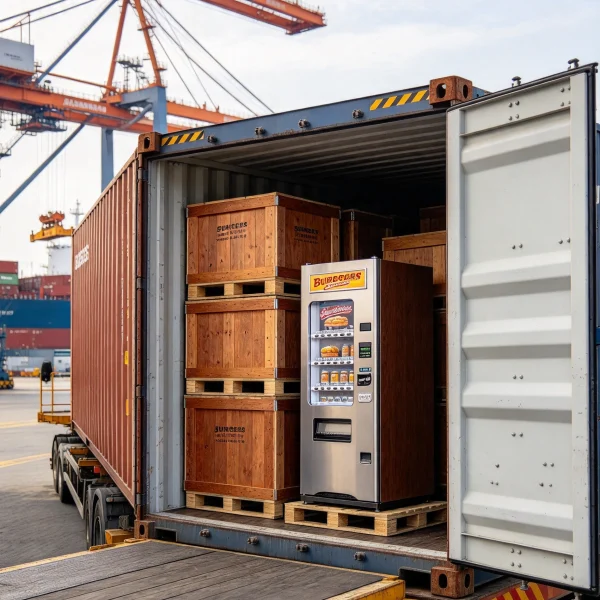
That parts kit sounds optional until a $60 pump fails and the machine sits dead for three weeks waiting on air freight. Budget for it in the first order, not the second.
Specs that decide whether the machine survives year one
Brochures all look alike. These are the lines worth digging into before you sign.
| Spec | What to ask for | Why it matters |
|---|---|---|
| Refrigeration | Forced-air cabinet holding 2°C to 8°C, R290 or R134a | Patty temperature drives your food safety log |
| Oven | One or two chambers, 180°C to 230°C, PID control | Two chambers roughly double hourly output |
| Payment | MDB protocol board, Nayax or PAX card reader, QR support | MDB lets you swap readers without rewiring |
| Power | 220V/50Hz or 110V/60Hz, 3.0 to 6.5 kW | A 6.5 kW unit trips a shared 16A circuit |
| Telemetry | 4G or WiFi module with stock and fault alerts | Cuts restock trips and empty-slot revenue losses |
| Compliance | CE, UL or ETL, food-contact report for the food zone | Some landlords and health officers ask for these |
Refrigeration and hold time
Ask how long patties can sit at 4°C before they must be sold or discarded. A cabinet that recovers slowly after each door cycle warms the whole stack, and your waste climbs. Forced-air cooling beats a static cold plate every time in a machine that opens and closes all day.
Payment and telemetry
MDB is the language most card readers speak, so insist on an MDB board even if the factory ships a proprietary terminal. That single detail saves you from a costly retrofit in 2027 when you want contactless or a local wallet. Telemetry matters just as much. Without remote fault alerts, a jammed gripper can sit unnoticed for a full weekend.
Voltage, power, and floor loading
A dual-oven machine pulls serious current. Check the breaker, the cable gauge, and whether the socket sits within two meters of the machine. Water access matters too if you plan to serve any fried item alongside the burger.
Vetting a supplier without flying to Guangzhou
You don’t need a plane ticket. You need four documents and one live call.
- Business license matching the bank account name on the invoice.
- Test certificates for the electrical and food-contact parts, with report numbers you can look up.
- Two or three reference buyers in your region, ideally operating the same model for a year or more.
- A written warranty of 12 to 24 months naming the parts covered and the response time for spares.
Then book a video walk-through. Ask the engineer to open the refrigeration cabinet and the oven chamber on camera. If the sales rep deflects, that tells you plenty.
On VendingCore you can compare verified suppliers side by side, read buyer reviews, and send an inquiry directly instead of cold-messaging five Alibaba accounts and hoping one replies. The same supplier-vetting framework we use for custom print kiosks applies here: documents first, references second, price last.
Run the payback math before you order
Here’s a working model for a campus location in 2026. The burger sells for $5.50, ingredients cost about $1.90, so gross profit lands near $3.60 per unit. At 40 burgers a day, that’s 1,200 burgers a month and roughly $4,320 in gross profit.
Now subtract the boring stuff: site commission or rent around $900, electricity $220, restocking labor $500, telemetry $15, and a maintenance reserve of $150. That leaves about $2,535 a month. On a $14,000 landed cost, break-even sits around 5 to 6 months. Drop to 25 burgers a day and the same machine takes closer to 9 months. Our breakdown of whether most vending machines are profitable shows the same pattern: volume is everything, and the machine is rarely the bottleneck.
Product mix matters as much as footfall. If you’re deciding between this and a simpler machine, the data on the most profitable items for vending machines is worth ten minutes of your time.
Where these machines earn their keep
Footfall alone isn’t enough. You want hungry people who can’t easily buy a burger somewhere else at that hour.
University campuses with 15,000 or more students, industrial parks running night shifts, highway service areas, hospital staff canteens, and 24-hour gas stations all fit that profile. Malls can work too, though the placement logic is closer to what we covered for mall vending placements: go where people wait, not where they walk past.
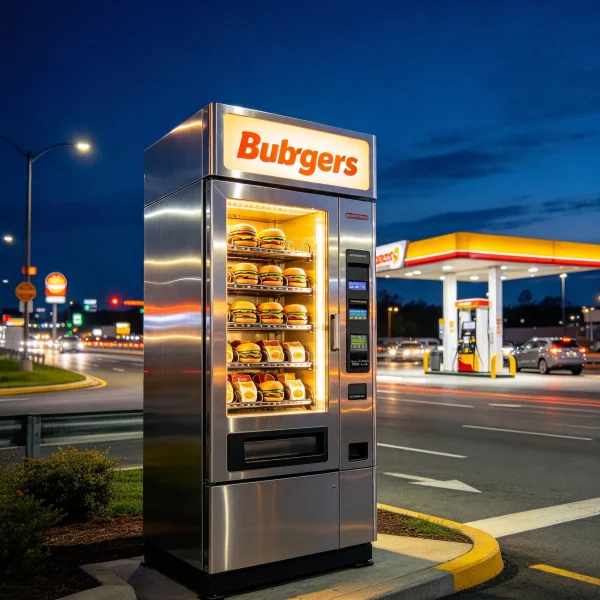
One practical note on restocking. A mid-tier machine empties in two to three days at 40 units a day. If your route can’t reach the site twice a week, size up to the dual-oven model or pick a slower location on purpose.
What to do next
Work in this order: lock the location and its power supply, get three quotes on the same spec sheet, then compare suppliers on documents and references rather than on price alone. A $1,500 gap between two factories rarely justifies a supplier who won’t answer emails after the container ships.
When you’re ready to shortlist, browse the supplier directory on VendingCore, filter by machine type and region, read what other buyers reported, and send an inquiry directly to the suppliers that fit. You’ll get comparable quotes in days instead of weeks.
FAQ
How much does a burger vending machine from China cost?
FOB prices run from about $6,500 for a countertop single-oven unit to $22,000 for a dual-oven high-capacity model. Add ocean freight of $700 to $1,400, import duty of 0 to 5 percent, brokerage, inland delivery, and a spare parts kit. A realistic landed figure for a mid-tier machine quoted at $12,000 FOB is $13,300 to $15,200. Ask for a quote valid for at least 30 days, since steel prices and exchange rates move.
How long does shipping from China take?
Production usually takes 20 to 35 days after deposit. Sea freight adds 18 to 35 days depending on the port pair, so budget six to ten weeks door to door. Air freight is possible for a countertop unit but rarely makes sense for a 300 kg cabinet. If you need the machine running for a specific season, order one quarter ahead of your target launch date.
Does it cook raw patties or reheat pre-cooked ones?
Both designs exist. Raw-patty machines use higher oven temperatures and longer cycles, usually 75 to 120 seconds, and need stricter food safety logs. Pre-cooked or par-cooked patties reheat in 45 to 70 seconds and simplify your cold chain. Many operators outside Asia choose par-cooked patties because the supplier network is easier to build and staff training is faster.
What certifications should I ask a supplier for?
Ask for CE or UL/ETL for the electrical system, a food-contact test report covering the burger path, an ISO 9001 factory certificate, and a refrigerant declaration. Report numbers matter more than logos. A supplier who sends scanned PDFs with traceable numbers is usually a supplier who keeps records, which is what you want when a health inspector or landlord asks questions.
Which payment methods can the machine accept?
Most export units ship with an MDB board that supports notes, coins, and a card reader, plus QR payments if you need them for Asian markets. Card readers from Nayax, PAX, or Ingenico are common and can be swapped later without rewiring. Cashless usually accounts for the majority of sales on a burger machine, so test the reader before you sign the site contract.
How much maintenance does one need?
Plan on a 15 to 25 minute daily clean of the food zone and delivery door, a weekly deep clean of the dispenser pumps and gripper, and a monthly check on the refrigeration seals and oven elements. Realistic parts spend is $80 to $200 a month averaged across the year. Keeping a spare pump, motor, and heating element on site cuts downtime from weeks to hours.
Can it run on 110V in the United States?
Yes, if you specify 110V/60Hz at the order stage. Retrofitting a 220V machine later means a new heating element, control board settings, and possibly a transformer, which costs more than ordering the correct version. A dual-oven unit still draws enough current to need a dedicated circuit, so have an electrician confirm your panel capacity before the container arrives.
Where can I compare suppliers and get a quote?
VendingCore is a supplier directory for vending machines, not a manufacturer. You can compare verified suppliers, check price ranges, read real buyer reviews, and send an inquiry directly to the factories that match your spec. Start with two or three quotes on an identical spec sheet, then judge on documents, references, and warranty terms, not on the lowest number alone.
The buyers who succeed with imported food machines aren’t the ones who negotiated the hardest on price. They’re the ones who spent two extra weeks on the location and the power supply before they ordered anything. I’ve seen a $9,000 machine outperform a $20,000 one simply because it sat where people were already standing at 11 pm with cash in hand. Get the spec sheet and the site right, and the machine becomes the easy part.