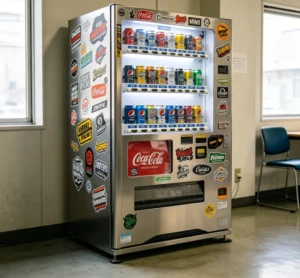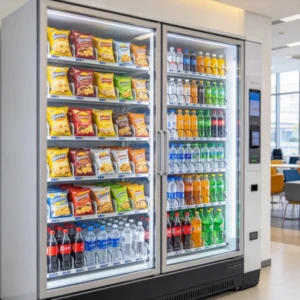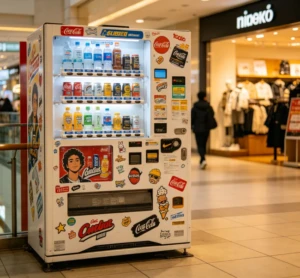
A drink and snack vending machine from China typically costs $1,200 to $3,800 per unit FOB, ships in 15 to 30 days, and often carries a minimum order of just one machine. That money buys a combo cabinet with a refrigerated drink bay plus coil or pusher trays for bagged snacks, wired to MDB so you can fit whatever card reader your country uses. You’ll see these units working in office corridors, factory canteens, dorm lobbies, gyms, and truck stops where a staffed kiosk would never break even. Most operators start with one, learn the route, then order five more.
What’s actually inside a combo cabinet
A combo vending machine is one steel cabinet split into two temperature zones. The refrigerated side runs at 3 to 8°C and holds cans and bottles in coils, on pusher trays, or behind a glass elevator that lifts the product and drops it into the delivery bin. The ambient side holds chips, biscuits, candy, instant noodles, and anything else that moves in your spot.
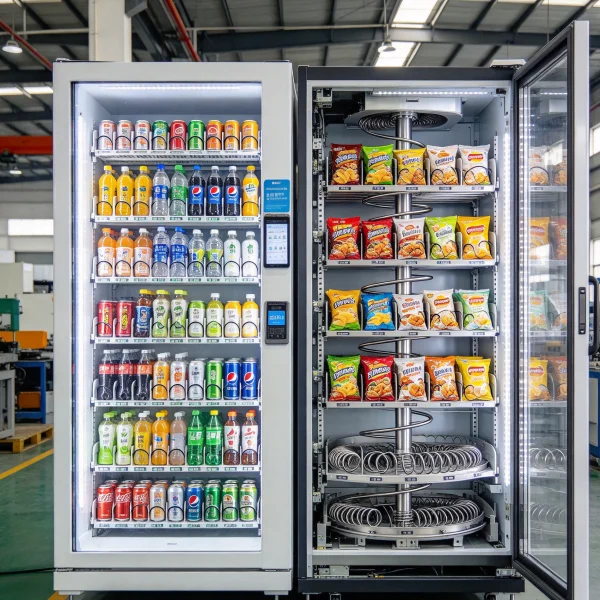
Two standards decide how flexible the machine will be once it lands. MDB (Multi-Drop Bus) is the protocol that lets the controller talk to coin mechanisms, bill validators, and card readers, so an MDB machine accepts almost any payment terminal you can buy locally. DEX is the audit data format that pushes sales numbers into route software instead of you counting cash at midnight.
Capacity is where cheap machines cheat. A cabinet sold as 8-layer might hold 240 items, or it might hold 120 because the trays are narrow and the coils are short. Ask for the item-level breakdown: how many cans, how many 500ml bottles, how many snack rows, and the maximum product dimensions each tray type accepts.
What the main configurations cost
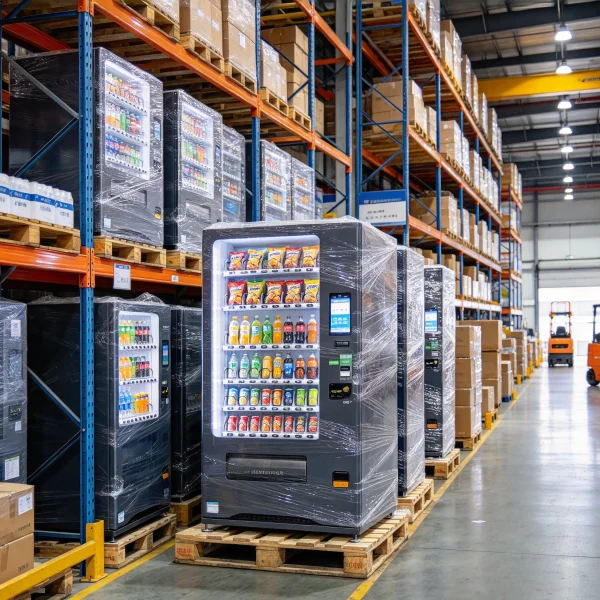
Chinese factories were quoting these numbers in early 2026, FOB Shenzhen or Ningbo. Layer count, refrigeration, and the glass front move the price more than brand name does.
| Configuration | Typical capacity | FOB price (USD) | Where it earns its keep |
|---|---|---|---|
| 6-layer combo (3 drink, 3 snack) | 180 to 260 items | $1,200 to $1,900 | Offices, school corridors, small canteens |
| 8-layer combo with glass front | 280 to 400 items | $2,000 to $3,200 | Malls, transit hubs, hospitals |
| Elevator combo for boxed or fragile goods | 200 to 320 items | $2,400 to $3,400 | Cosmetics, boxed meals, glass bottles |
| Outdoor weatherproof combo | 250 to 380 items | $2,600 to $3,800 | Truck stops, parks, construction sites |
| Drink-only refrigerated cabinet | 300 to 500 cans or bottles | $1,400 to $2,400 | Gyms, factory floors, warehouses |
The gap between a 6-layer and an 8-layer cabinet is smaller than most first-time buyers expect. What actually shifts your budget is freight, and how you choose to ship.
The landed cost nobody quotes you
Ask for the FOB price and a supplier replies within the hour. Ask for the landed figure and the conversation slows down. Freight, duty, clearance, and trucking add 40 to 70 percent to the cost of a single machine, which is why a cabinet you saw advertised at $1,500 can arrive costing $2,400.
| Cost line | Typical amount per machine | What changes it |
|---|---|---|
| FOB machine price | $1,200 to $3,800 | Layers, refrigeration, glass front, payment hardware |
| LCL sea freight | $250 to $600 | Shared container; a 20ft box fits 12 to 18 combos |
| Full 20ft container | $1,800 to $3,500 | Cheaper per unit once you pass 8 machines |
| Import duty | 0 to 8% of FOB | HS code 8476.81 and your country’s trade agreements |
| Customs clearance and port fees | $150 to $400 | Port, broker, and whether you get inspected |
| Inland trucking | $80 to $500 | Distance and whether you need a liftgate |
| Landed total, single unit by LCL | $2,000 to $5,000 | Door to door usually takes 30 to 55 days |
Coil, pusher or elevator: match the mechanism to the product
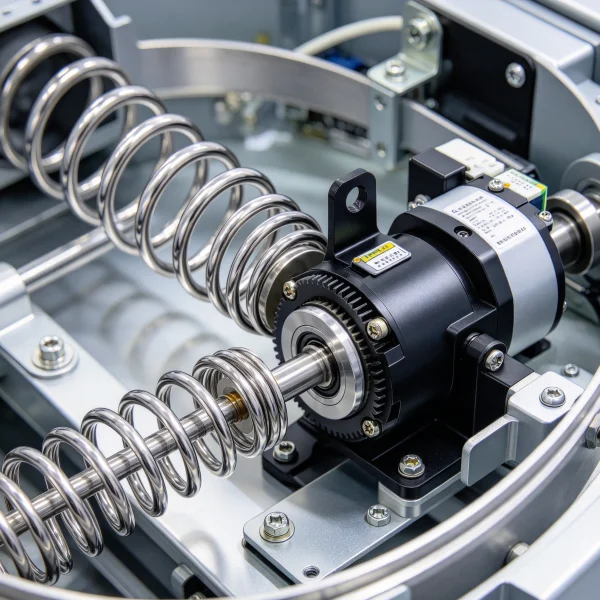
Coils are cheap and they work fine for cans and firm bags. Load a bag of crisps too loosely and it tips forward and jams the tray halfway down. Pushers handle boxes and flat packs better because they shove the whole stack forward. Elevators cost the most, and they’re the only sane choice for glass bottles, cosmetics, and anything that can bruise.
- Coil pitch runs 60mm to 90mm, and a can needs the right one or it falls through the spiral.
- Pusher trays suit boxed goods and multipacks, but they take more shelf space per item.
- Elevators vend slower, sometimes 15 seconds, and treat fragile products gently.
How to vet a supplier without flying to Shenzhen
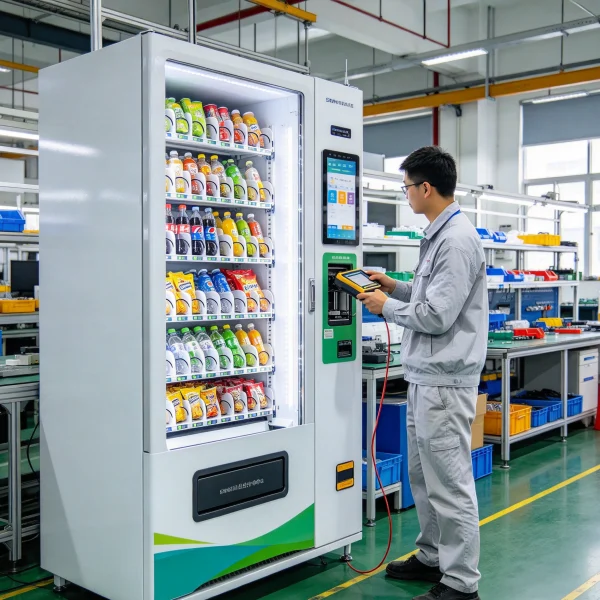
You don’t need a plane ticket. You need documents and a supplier who answers awkward questions without getting defensive. The same checklist works whether you’re buying a combo cabinet or a custom kiosk, and it’s the approach laid out in this sourcing and supplier guide for buyers.
- Business license with a company name that matches the invoice and the bank account
- Video of your exact model being tested, with your order number written on a card in the frame
- Certificate numbers for CE, RoHS, or UL components, not just a scanned page
- At least two references from buyers in your region, with contact details
- A named after-sales contact whose working hours overlap yours
- Spare parts price list and warranty terms written into the sales contract
Comparing several quotes side by side is the quickest way to spot the outlier. On VendingCore you can compare verified suppliers, read buyer reviews, and send an inquiry directly instead of emailing twenty listings and waiting for replies.
Customs and paperwork: the part that stalls orders
Vending machines ship under HS code 8476.81 in most countries. Your supplier needs that code on the commercial invoice along with the model number and the exact unit count, because a mismatch between the invoice and the packing list is what triggers a customs hold. Two documents cause the most delays: a certificate of origin where the shipper name doesn’t match, and a missing CE or UL file when the port authority asks for electrical compliance.
Budget one extra week for clearance on your first shipment. After that, your broker knows the product and it moves faster.
Where these machines actually pay for themselves
Location beats machine spec every time. A $1,400 combo in a 200-person office with no canteen will out-earn a $3,500 glass-front unit parked in a quiet mall corridor. Good spots share a few habits: foot traffic that repeats daily, no competing food within a two-minute walk, and a power socket you don’t have to negotiate for.
Rough payback math for a mid-range $2,000 combo, counting machine plus landed cost:
- Office lobby with 150 to 250 staff, 60 to 90 vends a day: payback in 6 to 9 months
- Factory canteen serving shift workers: payback in 4 to 6 months
- Suburban gym with evening traffic: payback in 8 to 10 months
- Street corner with no anchor tenant: usually never breaks even
If you’re still deciding whether running a route suits you, this honest breakdown of vending machine business pros and cons covers the parts nobody puts in a brochure. Novelty formats built in the same Chinese factories, such as the blind box units behind the lucky box debate in Australia, can pull crowds, but they live or die on licensing and local rules.
What to do before you wire the deposit
Write down the spec you need, ask five suppliers for exactly the same thing, and compare the answers line by line. The supplier who responds slowly but precisely is usually the safer bet over the one who replies in four minutes with a copy-paste quote.
Then use VendingCore to compare verified suppliers, check price ranges for the configuration you want, and send inquiries to the ones that fit. You’ll hear back from suppliers who already ship to your region, and you can read what other buyers say before you commit.
FAQ
How much does a drink and snack vending machine from China cost in 2026?
Expect $1,200 to $1,900 for a 6-layer combo, $2,000 to $3,200 for an 8-layer glass-front model, and $2,600 to $3,800 for an outdoor or elevator unit. Those are FOB prices, so add $400 to $1,200 for freight, duty, clearance, and trucking on a single machine. Buying three or more and sharing a container cuts landed cost per unit by roughly 15 to 25 percent.
What is the minimum order quantity?
Most Chinese combo machine factories will sell a single unit, though the price is higher and they may ask you to cover export documentation. An MOQ of two to five units usually unlocks a 5 to 10 percent discount, and a full 20ft container holds 12 to 18 combos. Trading companies often have lower minimums because they consolidate orders from several buyers at once.
How long does shipping from China take?
Production runs 15 to 30 days after deposit and artwork approval. Sea freight from Ningbo or Shenzhen takes 18 to 25 days to a US west coast port and 28 to 40 days to Europe. Door to door with customs clearance usually lands between 30 and 55 days. Air freight exists for samples but rarely makes sense for a machine weighing 300kg or more.
Which payment systems do these machines support?
Any machine wired to MDB accepts third-party card readers, coin changers, and bill validators, which matters because payment hardware approved in China may not work in your country. Ask the factory to leave the MDB harness accessible and confirm which coin and bill types your market uses. Many operators fit a local card reader after arrival, plus a QR module for mobile wallets.
Do Chinese suppliers provide spare parts and technical support?
Reputable factories stock coils, motors, compressors, control boards, and glass panels, and they’ll quote a spare parts kit with the machine. The gap is usually response time, not parts availability. Before ordering, ask who answers technical questions, in which language, and during which hours. A supplier with an English-speaking engineer in a matching time zone saves you days whenever something jams.
Should I buy from a factory or a trading company?
Factories give better prices on volume and can customize the cabinet, the branding, and the payment setup. Trading companies handle small orders, mixed products, and export paperwork more comfortably, and they often reply faster in English. For a first order under five units, a good trading company means less friction. Above ten units, deal with the factory directly.
How do I verify a Chinese supplier before paying a deposit?
Request the business license, a video of the exact machine being tested with your order number visible, certificate numbers for CE or UL components, and two references from buyers in your region. Pay through a platform with order protection or a letter of credit for the first order rather than a direct wire. On VendingCore you can compare verified suppliers, read buyer reviews, and send inquiries to several at once.
I’ve bought machines from four Chinese factories and the pattern never changes. The quote that arrives in ten minutes is rarely the one that ships on time. The supplier who asks about your location, your power supply, and what you plan to stock is the one who ends up sending spare coils before you ask. Spend the extra week on due diligence. A jammed tray in a busy canteen costs more in one afternoon than the discount you negotiated.