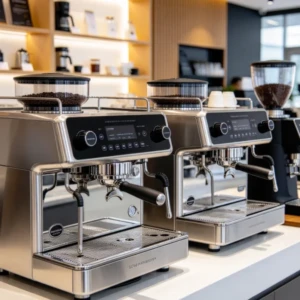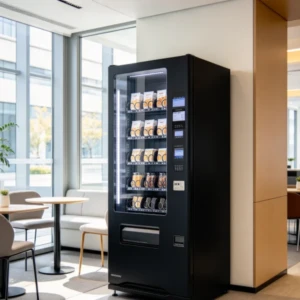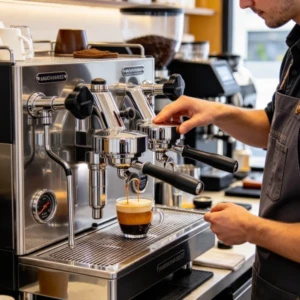
China produces over 2 million vending machines annually, with coffee vending machines accounting for roughly 15-20% of that output as of 2025. These machines are now found in office buildings, train stations, hospitals, and university campuses across the country — and increasingly, global buyers are turning to Chinese manufacturers to source them.
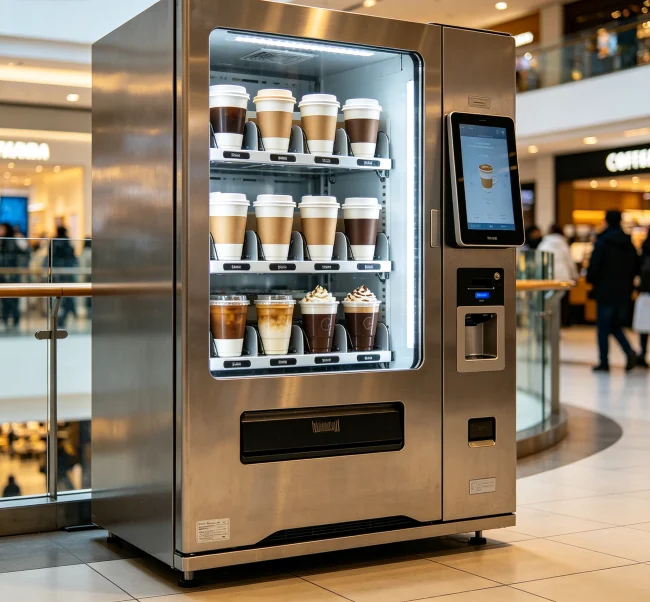
The reason is simple. Chinese factories have shifted from basic knockoffs to genuinely innovative products. You’ll find everything from compact countertop bean-to-cup machines to massive 50-inch touchscreen models that grind fresh beans and brew latte art in under 30 seconds. And the pricing? It’s often 30-50% lower than comparable European or American brands.
But here’s the thing — not every “factory” you find online is actually a manufacturer. Many are trading companies posing as factories. So how do you separate the real deal from the middlemen? Let’s break it down.
What Makes China a Leading Source for Coffee Vending Machines
China’s dominance in coffee vending machine manufacturing didn’t happen overnight. It’s the result of a perfect storm: decades of electronics manufacturing experience, a massive domestic coffee boom, and aggressive government support for smart manufacturing.
Walk through any industrial park in Guangdong or Zhejiang, and you’ll see why. Factories here have integrated AI-driven quality control, automated assembly lines, and advanced testing labs. The old stereotype of “cheap Chinese goods” is outdated — today’s products often carry CE, UKCA, RoHS, and even UL certifications.
Take the smart vending machine segment, for example. Chinese manufacturers were early adopters of IoT technology. Their machines now support remote monitoring, cashless payments, and predictive maintenance alerts. That’s not just competitive — for many features, it’s industry-leading.
The domestic market drives this innovation too. China’s coffee culture has exploded, with the market growing at 15-20% annually. Local operators demand reliable, feature-rich machines. Manufacturers respond by building better products. And those same products are then exported worldwide.
Types of Coffee Vending Machines You Can Source from China
When you start searching for coffee vending machines in China, you’ll quickly notice the variety. It’s not a one-size-fits-all market.
Bean-to-cup machines are the most popular category. These grind fresh beans for each cup, offering superior taste. Chinese manufacturers have gotten really good at this — their brew units are often licensed from or inspired by Italian designs, but adapted for high-volume commercial use.
Traditional powder-based machines still have their place, especially in high-traffic locations where speed matters more than gourmet quality. These are cheaper upfront and easier to maintain.
Then there’s the combination machines — part coffee, part snack, part cold drink. These are huge in China right now, especially in locations where floor space is limited. One machine can serve coffee, tea, juice, and chips. It’s efficient, and operators love the higher revenue per square foot.
You’ll also find specialized models:
Each type comes with different specs, price points, and supplier requirements. That’s why knowing exactly what you need before contacting manufacturers is crucial.
💡 Key Tip: Before reaching out to any supplier, define your target location, daily sales volume, and preferred payment methods. This saves weeks of back-and-forth.
How to Find Reliable Coffee Vending Machine Manufacturers in China
This is where most buyers get stuck. You search “coffee vending machines in China” on Google and get thousands of results. Which ones are real manufacturers? Which ones will deliver quality?
Here’s the approach that works.
Start with B2B platforms like Made-in-China or Alibaba. These give you a broad view of what’s available. Look for suppliers with “Manufacturer” or “Factory” badges, not “Trading Company.” Check their verification status — Gold Supplier, Assessed Supplier, etc.
Then verify independently. Ask for factory photos and videos. Request a live video call where they walk through their production line. A real manufacturer will happily do this. A trading company will make excuses.
Check certifications. Legitimate manufacturers will have CE, RoHS, or other relevant certifications. Ask to see them. If they hesitate, that’s a red flag.
Request samples. This is non-negotiable. Have them ship a sample machine to your freight forwarder in China or directly to you. Test it thoroughly — brew quality, reliability, touchscreen responsiveness, payment system integration.
Visit if possible. China’s major manufacturing hubs — Guangzhou, Shenzhen, Shanghai, Hangzhou — are well-connected by international flights. A factory visit tells you more than any email exchange ever could.
But here’s the reality — most buyers can’t visit China. And even if you do, how do you know which factories to visit? That’s where a sourcing service like VendingCore comes in. Our team has spent years building relationships with vetted manufacturers across China. We know which factories produce quality machines and which ones cut corners. When you submit an inquiry through us, we match you with manufacturers that fit your specific requirements — saving you the headache of vetting dozens of suppliers yourself.
Key Specifications to Compare When Evaluating Suppliers
Once you’ve identified potential manufacturers, you need to compare apples to apples. Here are the specs that matter most.
Brew unit type and quality. This is the heart of the machine. Look for stainless steel or ceramic brew units. Plastic ones wear out faster. Ask about the brand of the brew unit — many Chinese manufacturers use Italian components.
Hopper capacity. How many beans can the machine hold? For high-traffic locations, you want at least 2-3 kg hoppers. For offices, 1 kg might suffice.
Water tank size. Larger tanks mean less frequent refills. For commercial locations, look for 15-20 liter tanks. Some machines can be plumbed directly to a water line — that’s ideal for permanent installations.
Touchscreen size and quality. This is the user interface. A 15-inch screen is standard. Higher-end machines offer 21-inch or even 32-inch screens. Make sure the screen is bright, responsive, and weatherproof if the machine will be outdoors.
Payment system compatibility. Does the machine support credit cards, mobile payments (Alipay, WeChat Pay, Apple Pay), and cash? Most Chinese manufacturers offer modular payment systems that can be customized for your market.
Remote management capabilities. Can you monitor inventory, sales, and machine status remotely? This is standard for modern machines, but the quality of the software varies. Ask for a demo of the management platform.
Warranty and after-sales support. This is critical. What’s the warranty period? Where are spare parts stocked? What’s the response time for technical support? Chinese manufacturers typically offer 1-2 year warranties. Some have overseas warehouses for faster parts delivery.
Price Ranges and What Affects Cost
Let’s talk numbers. Prices for coffee vending machines from China vary widely based on features, quality, and order volume.
Here’s a rough breakdown:
Several factors affect pricing. Order volume is the biggest — expect 10-20% discounts for container-sized orders (20-50 units). Customization also adds cost: custom branding, special color schemes, unique payment systems, or modified dispensing mechanisms.
Shipping and import duties add another 15-30% depending on your country. Don’t forget to factor in spare parts inventory (10% of order value is a good rule of thumb) and installation costs.
💡 Practical Advice: When negotiating, focus on total cost of ownership, not just unit price. A slightly more expensive machine with better reliability and lower maintenance costs will save you money in the long run.
Quality Control and Certification Requirements
Quality control is where many buyers get burned. Here’s how to protect yourself.
Third-party inspections are non-negotiable. Hire an inspection company like SGS, Bureau Veritas, or Intertek to check your machines before shipment. They’ll verify specifications, test functionality, and check for defects. This costs $300-500 per inspection but can save you thousands in returns.
Certifications matter. For European markets, you need CE certification. For the UK, it’s UKCA. For the US, UL or ETL. For Australia, RCM. Chinese manufacturers are increasingly getting these certifications, but verify — don’t just take their word for it.
Payment terms protect you. Never pay 100% upfront. Standard terms are 30% deposit, 70% before shipment. Better yet, negotiate 30% deposit, 40% before shipment, 30% after inspection. This gives you leverage if something goes wrong.
Document everything. Get written specifications, certification copies, and warranty terms in your contract. If the manufacturer speaks Chinese, use a bilingual contract. Ambiguity is your enemy.
Shipping, Logistics, and Import Considerations
Shipping from China is straightforward once you know the process. Here’s the quick version.
Sea freight is the most cost-effective option for container-sized orders. A 20-foot container holds 20-30 coffee vending machines depending on size. Shipping from Shanghai or Shenzhen to Los Angeles takes 15-20 days. To Europe, 25-35 days.
Air freight is faster but much more expensive — 5-10x the cost. Only use this for urgent orders or sample shipments.
Your shipping options:
Most first-time buyers prefer CIF or DDP. It’s simpler, though you pay a premium for the convenience.
Import duties vary by country. In the US, coffee vending machines typically fall under HTS code 8476.89.0000 with a duty rate of 0-2.9% depending on the specific model. In the EU, duties are similar. Always check with a customs broker before ordering.
💡 Critical Info: Always get shipping insurance. A container lost at sea or damaged in transit can wipe out your entire investment. Insurance is cheap — usually 0.5-1% of the cargo value.
Common Mistakes Buyers Make and How to Avoid Them
I’ve seen buyers make the same mistakes over and over. Here are the most common ones.
Mistake #1: Going with the cheapest option. The lowest-priced manufacturer is usually the one cutting corners on components, quality control, or after-sales support. You’ll pay for it later in repairs and downtime.
Mistake #2: Not visiting or inspecting. I get it — travel is expensive. But a $1,000 inspection trip can prevent a $50,000 mistake. At minimum, hire a third-party inspection company.
Mistake #3: Ignoring software quality. The hardware might be great, but if the remote management software is buggy or the touchscreen UI is clunky, your customers will hate it. Ask for a software demo before ordering.
Mistake #4: Underestimating spare parts needs. When a machine breaks down, you need parts fast. Order 10-15% spare parts with your initial order. It’s cheaper than paying for emergency shipping later.
Mistake #5: Not planning for localization. Your market might need different payment systems, languages, or cup sizes than what the manufacturer offers by default. Discuss these requirements early in the process.
How VendingCore Can Help You Source Coffee Vending Machines
Navigating the Chinese manufacturing landscape isn’t easy. Language barriers, time zone differences, and quality concerns make it risky for first-time buyers. That’s where we come in.
VendingCore is a professional B2B sourcing service that connects global vending machine buyers with qualified manufacturers. Our team has over 10 years of industry experience and deep relationships with factories across China. We don’t just give you a list of suppliers — we help you find the right match for your specific needs.
Here’s how it works:
What makes us different? We’re not a marketplace. We don’t list thousands of products. Instead, we focus on finding the right manufacturer for each buyer. Our network includes manufacturers that produce smart vending machines, beverage machines, snack machines, coffee machines, phone case machines, and more. We connect you with factories that meet international certifications like CE, UKCA, and RoHS.
Best of all, there’s no intermediary markup. We connect you directly with manufacturers. Submit an inquiry, and our sourcing experts will respond within 24 hours with personalized recommendations.