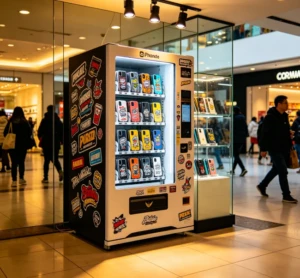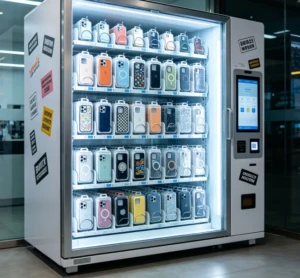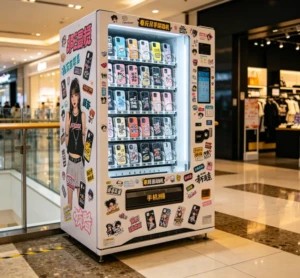
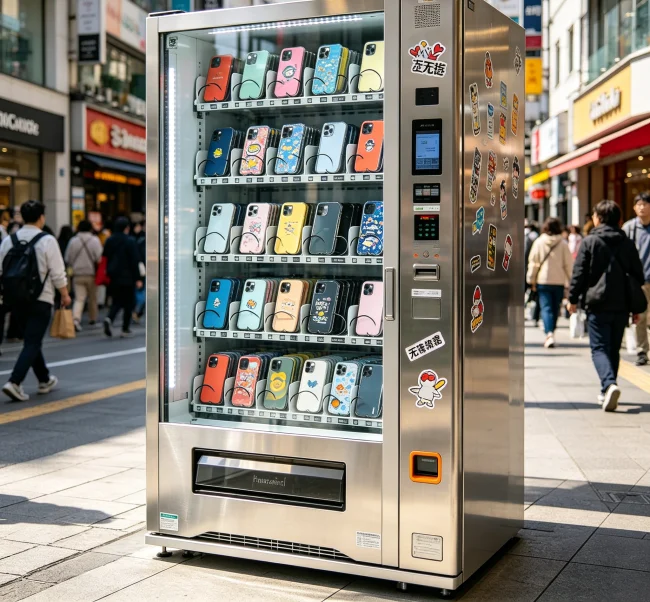
A phone case vending machine typically costs between $5,000 and $25,000, but the real price you’ll pay depends heavily on whether you’re buying a simple dispensing machine or a high-tech DIY printer kiosk that lets customers design their own cases right there in the mall. The cheaper end of that range gets you a basic unit that holds pre-made cases and dispenses them like a snack machine, while the higher end covers those interactive, print-on-demand kiosks that have become popular in tourist hotspots and shopping centers over the last couple of years.
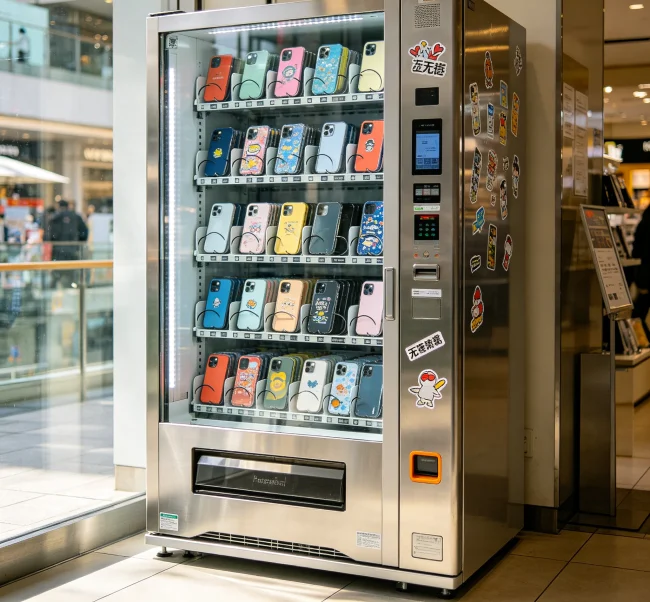
Why the Price Range Is So Wide
Look, I’m not going to sugarcoat this—there’s a massive difference between the machines available, and the price tag reflects that. A basic phone case vending machine (the kind that just stocks and dispenses) might run you $5,000 to $10,000. These are essentially modified snack vending machines with different shelving. They’re cheaper, simpler, and honestly, less exciting.
On the flip side, a DIY phone case printing kiosk—where customers upload a photo, design a case, and walk away with a custom product minutes later—can cost anywhere from $15,000 to $25,000 or more. These machines pack in a touchscreen interface, a high-quality UV printer, a heating unit for curing, and software for design processing. That technology isn’t cheap.
Then there’s the middle ground. Some manufacturers offer hybrid machines that both dispense pre-made cases AND offer limited customization options. Those typically fall between $10,000 and $15,000.
The brand matters too. Chinese manufacturers on platforms like Alibaba or Made-in-China might list machines for $4,000 to $8,000, but you’ve got to factor in shipping, import duties, and the reality that customer support might be… let’s say challenging. European or American-made machines tend to cost more upfront but often come with better support networks and certifications.
💡 Key Takeaway: Don’t just compare machine prices. A $6,000 machine with $4,000 in shipping and customs isn’t cheaper than a $9,000 machine with free delivery and local support.
Breaking Down the Total Cost of Ownership
Here’s where most people get tripped up. They see a machine price and think “that’s the cost.” It’s not. Not even close.
The machine itself is obviously the biggest chunk, but here’s what else you’re looking at:
Shipping and installation can add $1,000 to $4,000 depending on where you’re located and where the manufacturer ships from. Those DIY kiosks are heavy—we’re talking 300-500 pounds—so freight isn’t cheap. Installation might require a technician if you’re not handy with electrical work.
Location lease or rent is an ongoing cost that varies wildly. A spot in a busy mall might run you $500 to $2,000 a month. A partnership with a hotel or airport could be revenue-sharing instead of fixed rent. Don’t underestimate this—it’s often the difference between profit and loss.
Materials and inventory are recurring expenses. For a dispensing machine, you’re buying phone cases in bulk from suppliers. Expect to pay $3 to $8 per case wholesale, depending on quality. For a DIY printer, you’re buying blank cases (about $2 to $4 each) plus ink and other consumables.
Software and payment processing add up. Many DIY machines charge monthly software fees—$50 to $200 isn’t unusual. Credit card processing takes 2-4% of every transaction. And if you’re using a mobile payment system, there might be integration fees.
Maintenance and repairs are the wildcard. Printer heads wear out. Touchscreens break. Vending mechanisms jam. Budget at least $50-$100 a month for upkeep, or more if you’re not handy with repairs.
Standard Dispenser vs. DIY Printer Kiosk: The Real Cost Difference
Let me lay this out clearly because this choice fundamentally changes your business model and your budget.
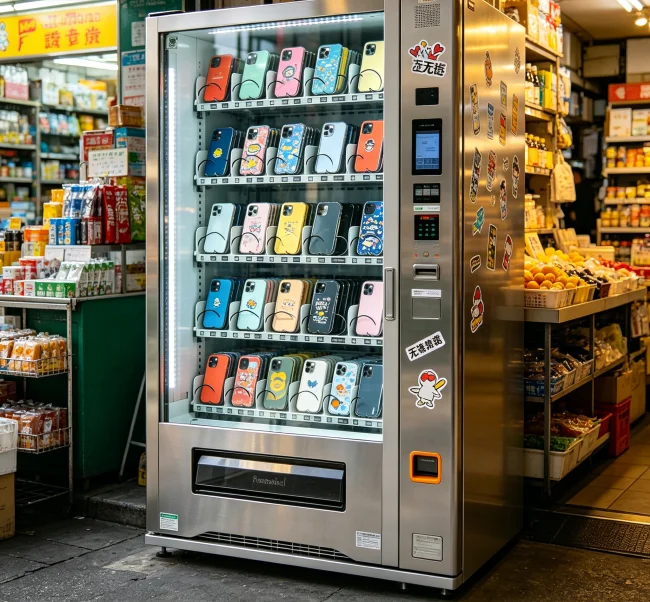
Standard phone case dispensers are basically glorified vending machines. You buy cases from suppliers, stock them, and sell them at a markup. The machine costs $5,000-$10,000. Your profit margin per case might be 50-100% (selling a $5 case for $10-$15). The upside? Lower initial investment. The downside? You’re competing with every Amazon seller and mall kiosk.
DIY printer kiosks are a different beast entirely. Customers design their own cases, and the machine prints them on demand. These machines cost $15,000-$25,000. But here’s the thing—you can charge $25-$40 per custom case, and your cost per blank case is around $2-$4. That’s a 500-800% markup. Plus, you’re selling an experience, not just a product. People pay more for personalization.
The DIY route also means you don’t need to carry inventory of hundreds of case models. You just need blank cases in a few standard sizes and a reliable printer. Less storage, less waste, less guesswork about what designs will sell.
💡 Practical Advice: If you’re new to this, consider starting with a DIY kiosk rather than a dispenser. Higher upfront cost, but much better margins and less competition. Just make sure you have the location to support the volume.
Hidden Costs Nobody Talks About
I’ve talked to several phone case vending machine operators, and they all mention costs that aren’t in the sales brochures.
Insurance is one. You’ll need liability insurance in case someone gets hurt using your machine or if it malfunctions. Expect $300-$800 a year.
Electricity isn’t huge but it’s not nothing. A DIY printer kiosk draws more power than a simple dispenser—figure $30-$80 a month depending on local rates.
Credit card chargebacks happen. Someone buys a case, their card gets stolen, and you lose the money plus a fee. Budget 1-2% of revenue for this.
Software updates and licensing can sneak up on you. Some manufacturers require annual software renewal fees. Others charge for firmware updates. Read the fine print before you buy.
Marketing costs—because nobody’s going to magically find your machine. You might need signage, social media ads, or partnerships with local influencers. Budget at least $200-$500 a month initially.
What You Can Expect to Earn (And How Fast You’ll Recoup Your Investment)
Here’s the part everyone wants to know. Can you actually make money with one of these?
With a DIY printer kiosk in a good location, operators report selling 10-30 cases per day. At $30 per case average, that’s $300-$900 daily revenue. Subtract costs (materials, location rent, fees), and you’re looking at $150-$500 profit per day. That’s $4,500-$15,000 a month in a prime spot.
With a standard dispenser, you’re selling pre-made cases for $10-$15 each. Volume might be higher (20-40 per day), but margins are lower. Daily profit might be $100-$300.
ROI timelines vary dramatically by location and machine type. In a good spot with a DIY kiosk, you might recoup your investment in 2-4 months. A standard dispenser in an okay location might take 3-6 months to pay itself off. But a bad location? You might never see a return.
The key variable is foot traffic and conversion. A machine in a busy mall corridor might see 50,000 people pass by daily. If just 0.1% buy something, that’s 50 sales. Same machine in a quiet hotel lobby? Maybe 500 people pass by, and you’re lucky to get 5 sales.
💡 Critical Info: Location is more important than the machine itself. A $5,000 machine in a great spot outperforms a $20,000 machine in a bad spot every single time. Prioritize location research over machine features.
How to Find the Right Supplier
This is where things get tricky, especially if you’re importing. There are dozens of manufacturers on Alibaba, Made-in-China, and other B2B platforms, but not all of them are reliable.
What to look for in a supplier:
Common mistakes buyers make:
This is where VendingCore can help. Our team has been connecting buyers with qualified vending machine manufacturers for over a decade. We know which suppliers are reliable, which machines actually perform, and which ones will leave you stranded with a broken kiosk. Instead of scrolling through hundreds of listings and hoping for the best, you can submit your requirements to us, and we’ll match you with manufacturers that meet your specific needs—whether that’s a budget-friendly dispenser or a high-end DIY printer.
Financing Options
Let’s be real—$15,000 to $25,000 is a lot of cash to drop on a machine. But there are ways to make it work.
Equipment financing is available through some vending machine manufacturers and third-party lenders. You put down 10-30% and finance the rest over 12-48 months. Monthly payments on a $20,000 machine might be $400-$600.
Small business loans from banks or online lenders work if you have decent credit and a solid business plan. Interest rates vary, but you can often get 6-12% APR.
Leasing is an option with some suppliers. You pay a monthly fee to use the machine, and the supplier handles maintenance. You don’t own the machine, but your upfront costs are much lower.
Crowdfunding or partnerships work too. Find a location partner who wants the machine and split the costs and profits.
💡 Key Takeaway: Don’t drain your savings to buy a machine outright if you’re not sure about the location. Start with financing or leasing to minimize risk. You can always buy outright once you’ve proven the concept works.
Is a Phone Case Vending Machine Worth It?
Honestly? It depends.
If you have access to a high-traffic location—a mall, tourist attraction, convention center, or busy transit hub—the numbers work. A DIY printer kiosk can generate serious revenue, and the novelty factor gives you an edge over traditional retail.
If you’re thinking about putting a machine in a random spot with moderate foot traffic, the math gets tighter. You’d need to sell a lot of cases to cover your costs, and competition from phone cases on Amazon (where they’re $5-$10 with free shipping) makes it harder.
The smartest approach is to start small. Get one machine, find a killer location, and prove the concept before scaling. Too many people buy three or four machines at once and end up with expensive paperweights in bad locations.